Dura-Europos: mudbrick architecture, the Roman house, and the Temple of Bel
the archaeological site
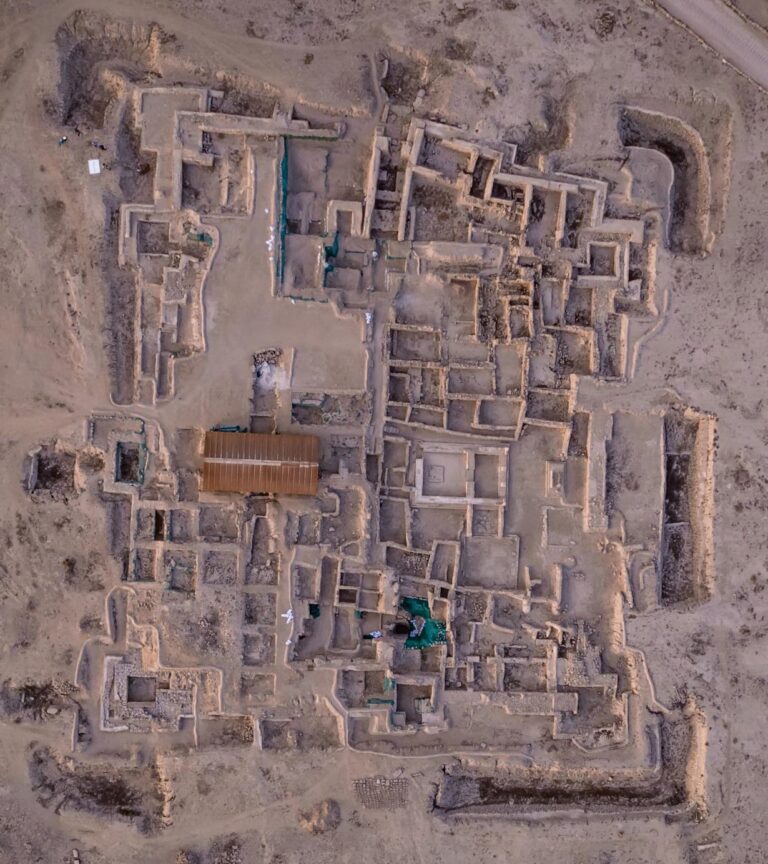
Dura-Europos on the Euphrates is located in the southeast of Syria, near the current border with Iraq. The city, covering just over 60 hectares and situated at a crossing point of the Euphrates, was a stop along the routes that led from east to west. It is believed to have been founded by Seleucus I, occupied by the Parthians around 113 BC, then by the Romans around 165 AD, before falling to the Sassanids around 260. The city was originally likely a smaller military fortress.
From 1993 to 2000, Mr. Gelin conducted a study on the mudbrick architecture of the city, investigating how it contributed to the history and development of urban planning in the city. This work also incorporated ethnological studies and experimental archaeology in order to reconstruct ancient construction sites and facilitate the preservation of the remains.
In general, Mr. Gelin took responsibility for the preservation and restoration of the mudbrick remains throughout the site, and participated in the restoration of major monuments such as the Christian house or the glacis of the city’s main gate (see also the Temple of Bel and the Roman house, below).
The results of the MEDA program
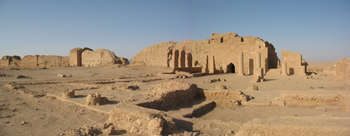
The results show that earth architecture, just like stone architecture, provides a great deal of information about a monument and its integration into the urban fabric. Several phases of urban development have been uncovered, and monuments, sometimes geographically separated on the site or previously not chronologically linked, have been connected to the same construction phase. This study made it possible to discover the different stages of construction of the mudbrick section of the western rampart as well as various reinforcement and development programs for the entire fortification system. In this way, it is the history of the city and its evolution that is better understood.
The results show that earthen architecture, just like stone architecture, provides a wealth of information about a monument and its integration into the urban fabric. Several phases of urban development could be identified, and monuments, sometimes geographically separated on the site or previously not chronologically associated, could be linked to the same construction phase. This study made it possible to uncover the different stages of construction of the mudbrick section of the western rampart, as well as various reinforcement and development programs for the overall fortifications. In this way, it is the history of the city and its evolution that is deepened. As part of the European-Syrian MEDA program for training DGAMS staff in heritage preservation, which took place from 2002 to 2004, a Roman house was reconstructed on ancient foundations to serve as a visitor center and a small site museum. Built on ancient foundations, the house was constructed using ancient techniques and original materials (architect Étienne Léna).
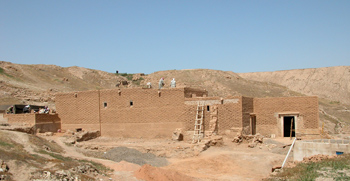
Photo E. Léna, French-Syrian mission of Dura-Europos.
Mr. Gelin’s collaboration, in addition to managing the program in the field, involved the stabilization of the building’s foundations; it also included advice and expertise for construction with raw bricks and, in 2005, participation in setting up the museum rooms for its inauguration.
As part of the MEDA program, Mr. Gelin took on responsibility for the study and restoration of the Temple of Bel. It is located in the northwest corner of the city; it was the first monument to be uncovered by earlier missions and revealed beautiful wall paintings, including the Sacrifice of Conon, which is preserved in the Damascus museum.
The first results of the archaeological study reveal various stages that preceded the temple. Indeed, the construction of the fortifications during the Hellenistic period (around the middle of the 2nd century BC) underwent several modifications, during which changes in the layouts were made.
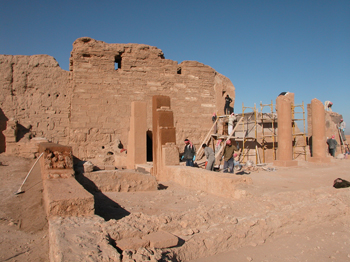
Photo M. Gelin, Franco-Syrian mission of Dura-Europos
At the beginning of the Parthian period, the entire area was used for artisanal purposes (several kilns were found), and the rampart was partly restored.
Finally, the temple itself is believed to date back to the middle of the Parthian period and underwent at least two major phases of construction. It lasted until the Roman period.
The archaeological study of the temple was not completed in 2011. The consolidations and restorations mainly concerned the pronaos, the columns of the west portico, the door, and the bases of the walls of the hall that contained the paintings of the “Palmyrene gods,” as well as numerous walls, benches, floors, and plasters. However, the restoration remains unfinished.
Bibliography
- M. Gelin, Histoire et urbanisme d’une ville à travers son architecture de brique crue : l’exemple de Doura-Europos, Thèse de doctorat, Univ. Paris I, Dir. J.-M. Dentzer et P. Leriche, juill. 2000.
- M. Gelin, “De l’Euphrate à l’Oxus: exemples de l’utilisation de la brique cuite à Doura-Europos etTermez”, éd. P. Boucheron, H. Broise, Y. Thébert, La brique antique et médiévale. Production et commercialisation d’un matériau, Collection de l’Ecole française de Rome, 2000, pp.53-69. https://hal.archives-ouvertes.fr/hal-03048585/document
- M. Gelin,”Le rempart en briques crues de Doura-Europos : la muraille grecque”, Doura-Europos Etudes 5 (1994-1997), A. Dandrau, M. Gelin, P. Leriche éds, Damas, 2004, éd. Geuthner, p. 213-236. https://hal.archives-ouvertes.fr/hal-03025956/document
- M. Gelin, “Le temple de Bêl à Doura-Europos. Résultats des derniers travaux (2002)”, Proceedings of the International Conference on Zenobia and Palmyra, Homs University oct. 2002, Homs, 2005, p. 165-187.
- M. Gelin, “Note sur les travaux au temple de Bêl à Doura-Europos (2002-2004)”, p. 333-335, dans Leriche P., Gelin M., Léna E., “Archéologie et patrimoine à Doura-Europos”, Résultats du programme de formation à la sauvegarde du patrimoine culturel de Syrie 2002-2004, Documents d’Archéologie syrienne 11, Damas, 2007, p. 329-350 (p. 351-362 pour la version arabe).
- M. Gelin, “La terre au secours de la pierre. Délais d’un chantier de construction hellénistique en briques crues à Doura-Europos sur l’Euphrate”, Arqueología de la construcción 2 : los procesos constructivos en el mundo romano : Italia y provincias orientales (Anejos de Archivo Español de Arqueología 57), éd. S. Camporeale, H. Dessales, A. Pizzo, Institut d’Archéologie de Mérida, Université de Sienne, École Normale Supérieure de Paris, Madrid-Mérida, 2010, p. 437-453. https://hal.archives-ouvertes.fr/hal-03024557/document
- Gelin M., “Conservation et mise en valeur du patrimoine archéologique au Proche-Orient : quelques réalisations de missions archéologiques”, Journal of Historical, Philological and Cultural Studies 27-1, En l’honneur des 75 ans de Guénnadi Andréïévitch Koshelenko, Académie des Sciences de Russie, Moscou-Magnitogorsk-Novossibirsk, 2010, p. 62-84, pl. 1. https://hal.archives-ouvertes.fr/hal-03010389/document
- Gelin M., Abdul Massih J., “Doura-Europos sur l’Euphrate, une cité grecque dévastée par les pilleurs clandestins”, éd. M. Al-Maqdissi, E. Ishaq, La Syrie et le désastre archéologique du Proche-Orient ”Palmyre cité martyre”, Beiteddine Art Festival, 2016, p.139-147. https://hal.archives-ouvertes.fr/hal-03026209/document