French Archaeological Mission of Petra
Director of the French archaeological mission in Petra: Laurent Tholbecq UMR 7041 ArScAn, OrAM Team (Nanterre) & Free University of Brussels (ULB)
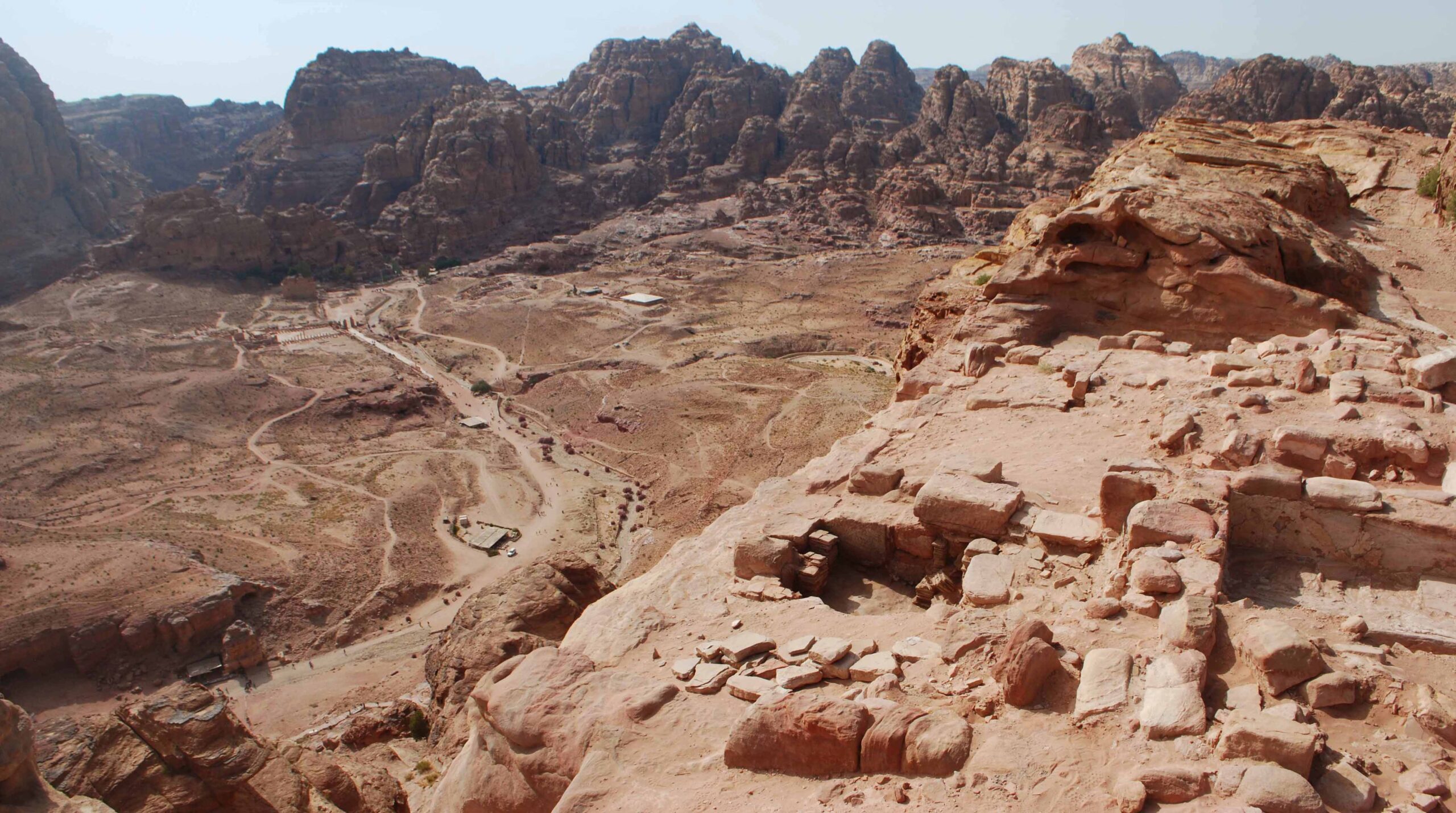
The French archaeological mission in Petra, which receives support from the Ministry for Europe and Foreign Affairs, works to study the religious spaces of the Nabataean capital.
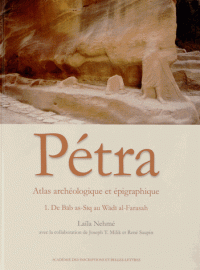
It has developed its programs around the Qasr al-Bint, the main temple of the Nabataean capital and a major urban planning hub of the city center. It thus continues a long tradition of French research in Petra, dating back to the first explorations of the site by L. de Laborde and L. M. Linant de Bellefonds (1828) and to the epigraphic work of Fathers M. J. Lagrange, R. Savignac, J. Starcky, and J. T. Milik, recently complemented by L. Nehmé’s publication of an Archaeological and Epigraphic Atlas of Petra (vol. 1, Paris, 2012 / Fig. 1).
Due to its location in the heart of the ancient city and the preservation of its entire elevation, the Qasr al-Bint is, alongside the Khazneh, one of the most iconic buildings in Petra. The excavation work, started by our British colleagues during the Mandate period, continued from 1979 under the direction of Fawzi Zayadine.
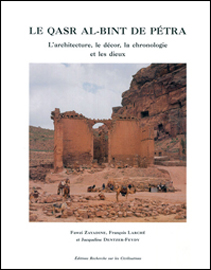
Because of the historical ties developed between this great Jordanian scholar and the French Institute in Beirut, a close collaboration was established with the Kingdom’s Antiquities Department as soon as Ernest Will opened a branch of the French Institute of the Near East in Amman (1977). These long-term efforts culminated in the publication in 2003 in Paris of a large-format monograph by F. Zayadine, Fr. Larché, and J. Dentzer-Feydy, Le Qasr al-Bint de Pétra, l’architecture, le décor, la chronologie et les dieux (Fig. 2).
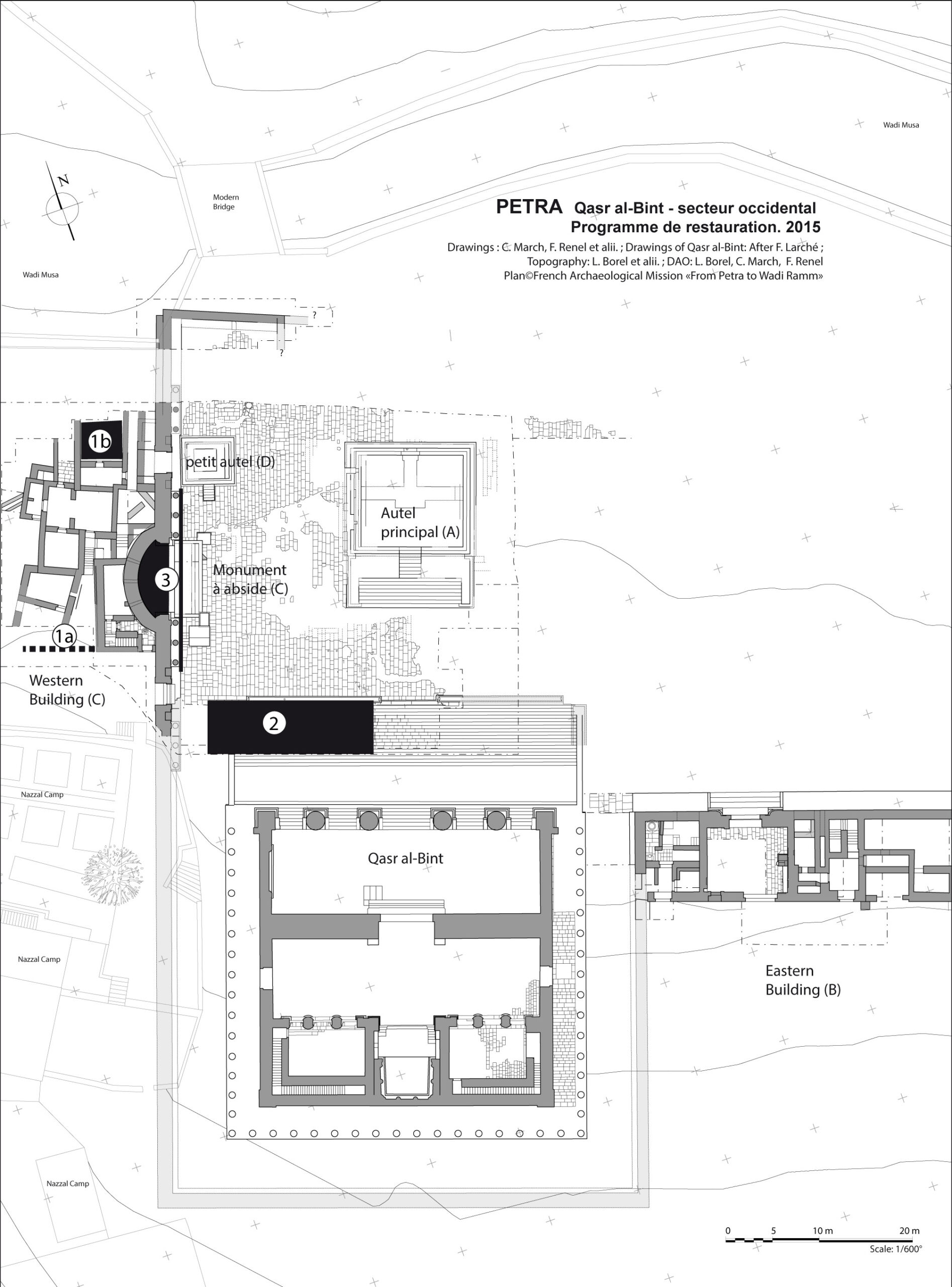
Restoration program (2015)
While the initial work focused on the building itself, the archaeological component, actively supported by Jean-Marie Dentzer and since 2000 under the responsibility of Christian Augé and François Renel, has provided fundamental results both on the cult building (long chronology, monumental altars) and its built environment (temenos partially uncovered during the British mandate, Propylaea and “Building B”, courtyard likely distributing banquet spaces), revealing an unexpected sequence of a millennium of occupation in what constitutes the heart of the urban settlement of Petra (Fig. 3). In particular, the discovery of an imperial monument with an apse, housing colossal representations of Marcus Aurelius and Lucius Verus, provides today a fundamental milestone in the history of imperial architecture in the Provincia Arabia (Fig. 4).
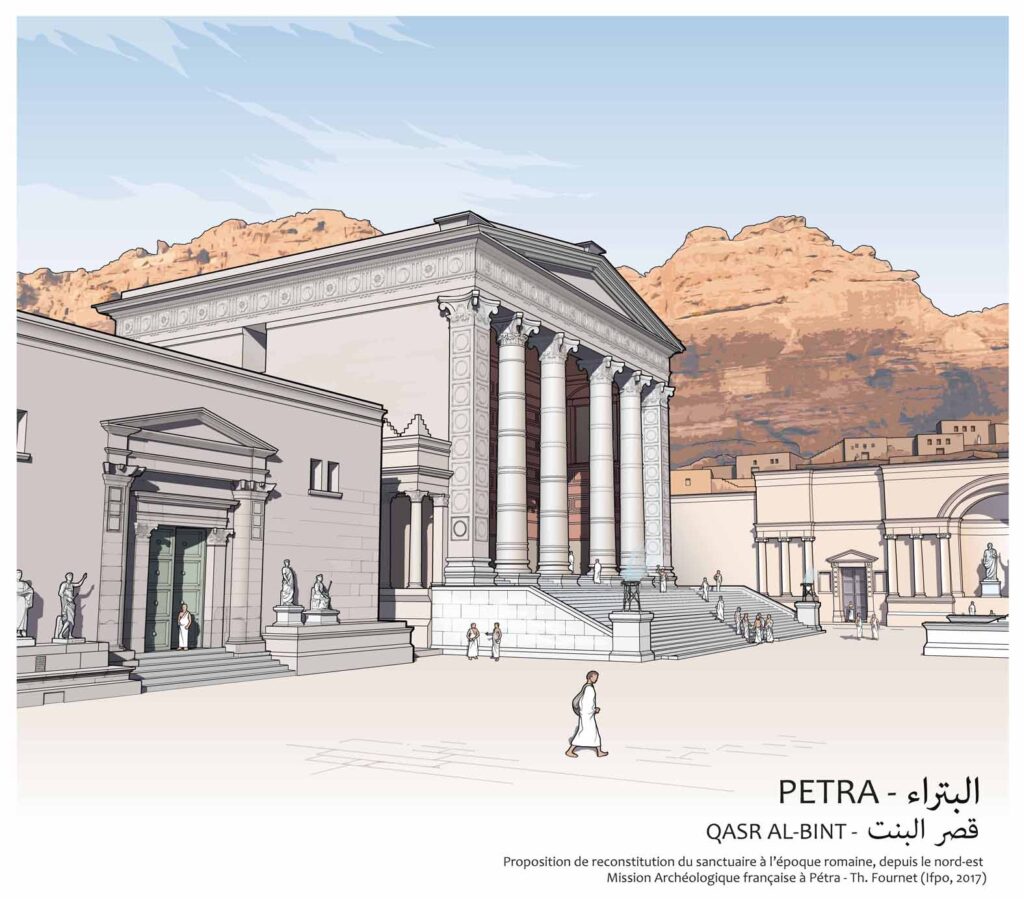
Even more fundamentally, the investigated sequence dates back to the very first occupations of the site, around the turn of the 4th and 3rd centuries BCE, which corresponds to the earliest mentions of the Nabataeans in ancient literature. In recent years, the team has focused its efforts on several interconnected buildings located to the east of Qasr al-Bint. Their arrangement around what appears to be the temple of the protective deity of the royal lineage, their layout, and the chronology of the remains point to a complex of a palatial nature, partially reused by the Roman authorities after the annexation of the kingdom.
Due to the city’s location in a mountainous environment, the sanctuaries of Petra show a significant distribution across an expanded urban space extending to various peripheries, with a marked hierarchy between public and private spaces. They thus include, alongside urban sanctuaries such as Qasr al-Bint or the anonymous temple known as “of the winged lions,” a large number of small peripheral sanctuaries of various types (betyl stands, oratories, meeting places for associations), which need to be characterized.
In addition to a spatial perspective that allows connecting the dispersed sanctuaries to the various tribes that comprised the Petraean society, this renewed exploration of the peripheral sanctuaries is justified by the obsolescence of G. Dalman’s work, who is credited with the first comprehensive study of the city’s sanctuaries (1908).
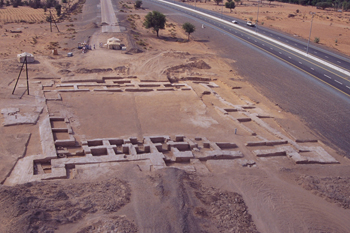
An initial project of the French Archaeological Mission in Petra focused on the ‘Chapel of Obodas,’ a tribal sanctuary on the outskirts, excavated in 2001 by L. Nehmé and then until 2013 under the direction of L. Tholbecq (Fig. 5).
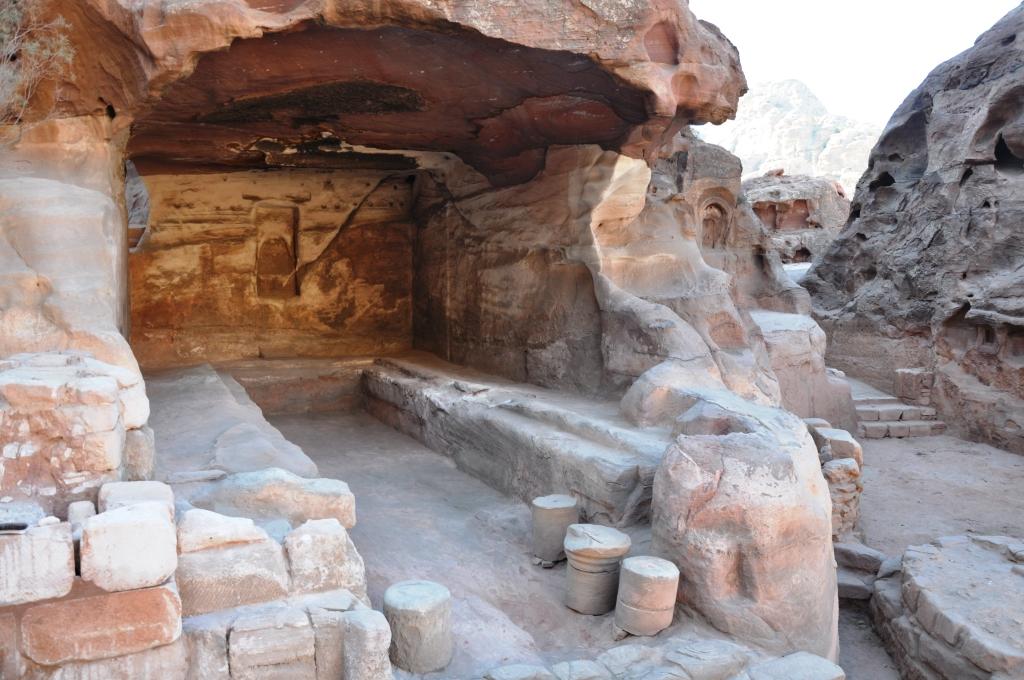
These studies led to the discovery of a tribal religious and meeting space that underwent significant structural developments (three major Nabataean phases recognized, from the mid-2nd century BCE), before the annexation of the Nabataean kingdom by Rome and the creation of the Provincia Arabia in 106 CE. This research justified the exploration in 2010 of the summit of Jabal Numayr, a ‘high place’ sanctuary topographically linked to the ‘Chapel of Obodas’.
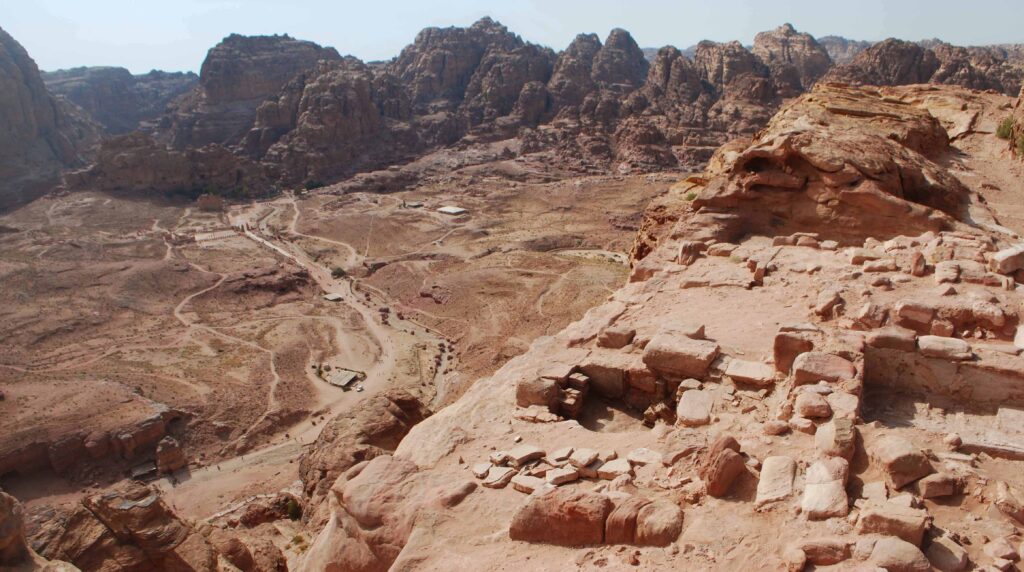
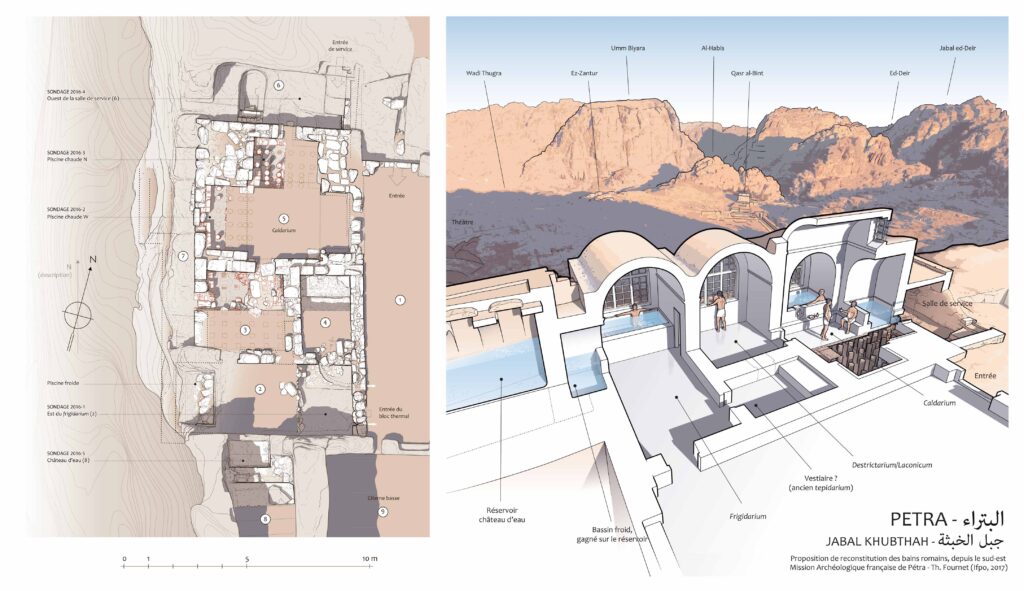
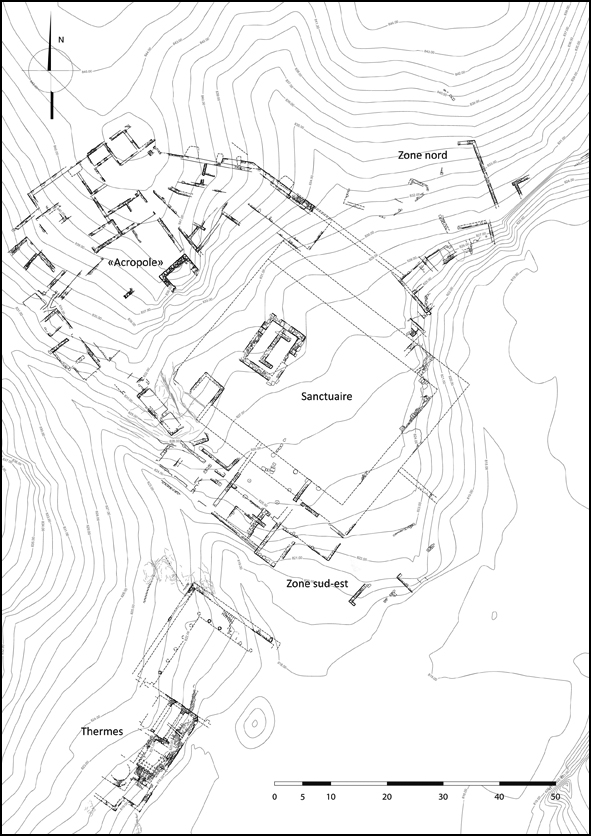
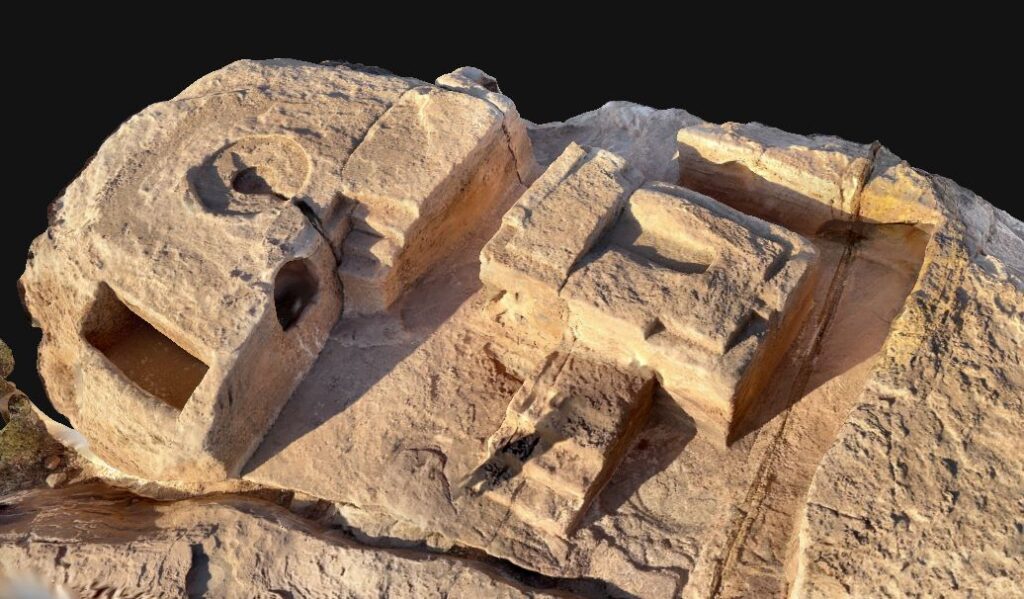
This opening to the issue of high-place sanctuaries led the French mission, in October 2012, in collaboration with the Belgian archaeological mission at Petra, to begin a systematic exploration of the summit of Jabal Khubthah. This has led to unexpected discoveries: a motab, a previously unknown betylus display structure, a platform (pavilion-like building or temple?) associated with a rock-cut stibadium, and above all a spectacular and quite unexpected elevated thermal complex (Fig. 6-7).
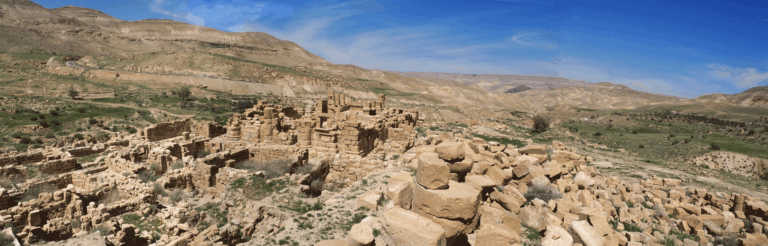
In October 2014, this exploration continued with the survey of an extra-urban sanctuary, located in Wadi Sabra, on the southern edge of the city (Fig. 8). The site underwent a partial excavation, focused on its rock-cut theater and a small adjacent building, possibly a caravanserai later converted into a small fort during the Late Roman period.
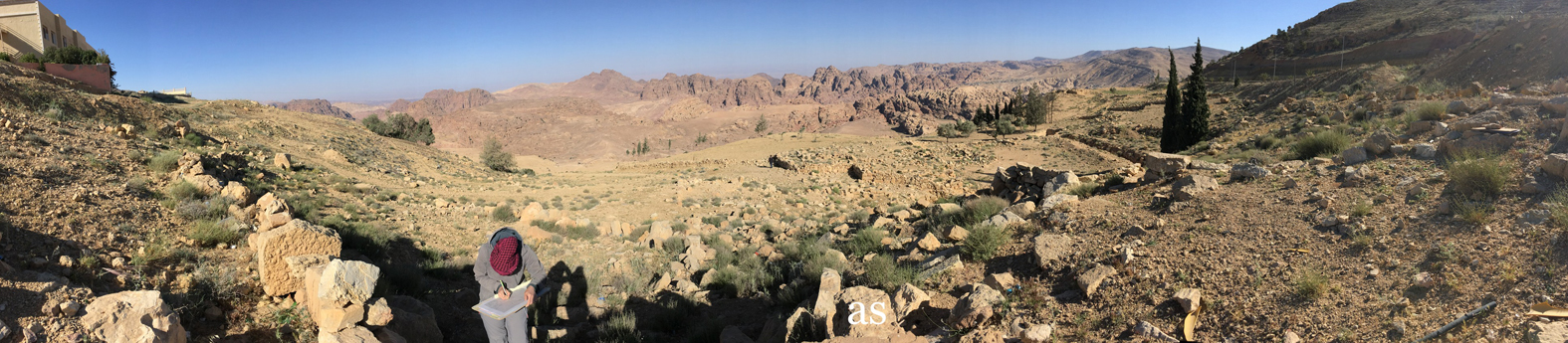
In May 2018, the French archaeological mission in Petra, in collaboration with the Belgian archaeological mission of the Free University of Brussels and al-Hussein Bin Talal University (Maan), began the survey and study of Khirbat Brâq, an important spring sanctuary located in Jabal Shara, the limestone mountain overlooking the Nabataean capital (Fig. 9).
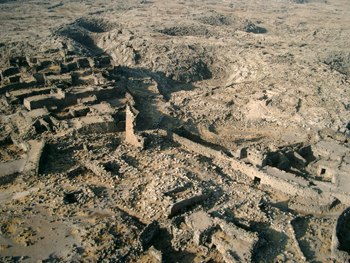
More recently, efforts have focused on a reassessment of the remains of Jabal Madhbah (the “Mountain of Sacrifice”), the most famous of Petra’s high places, as part of a privileged partnership agreement between the Free University of Brussels and the University of Lausanne (Fig. 10). These studies therefore make it possible to develop a new analytical model of the sanctuaries of the Nabataean capital and, consequently, to offer a renewed spatial interpretation of all the religious spaces of Petra.
Link to the mission reports:
https://ulb.academia.edu/LaurentTholbecq/Excavation-reports
Bibliography
- 2025
– L. Tholbecq « Petra during the Nabataean, Roman and Byzantine periods », In. R. Raja (Ed.), The Oxford Handbook of the Hellenistic and Roman Near East (4th century BCE – 8th century CE), Oxford, Oxford University Press, 2025, p. 813-827. - 2024
– L. Tholbecq « D’Alexandrie à Pétra : réflexions sur l’élaboration du vocabulaire architectural nabatéen, entre koinai péninsulaire, hellénistique et provinciale romaine », In. Eleni Fragaki, M.-D. Nenna & Miguel John Versluys (Eds.), Alexandria the cosmopolis: a global perspective. Actes de colloque. Alexandrie, 2-3-4 décembre 2019. (Études alexandrines, 56). Alexandrie, Centre d’Etudes Alexandrines, (2022) 2024, p. 197-226.
– L. Tholbecq, Th. Fournet & F. Renel, « Monumente der Macht. Römische Bauwerke im Herzen Petras », Antike Welt, 6, 2024, p. 32-36.
– L. Tholbecq, N. Paridaens & F. Renel, « Petra: Khirbat Sabra », In. Pearce Paul Creasman, Jack Green and China P. Shelton (Eds.), Archaeology in Jordan 4, 2022-2023 Seasons, p. 136-137.
– L. Tholbecq & N. Paridaens, « Petra: Main Theater », In. Pearce Paul Creasman, Jack Green and China P. Shelton (Eds.), Archaeology in Jordan 4, 2022-2023 Seasons, p. 141-142. - 2023
– L. Tholbecq, « Nabataean religious architecture: recent studies and trends in research », In. Jens Kamlah & Markus Witte (Eds.), Temples, Synagogues, Churches, and Mosques. Sacred Architecture in Palestine from the Bronze Age to Medieval Times, (Abhandlungen des Deutschen Palästina-Vereins, 49), Wiesbaden, Harrassowitz, 2023, p. 419-440.
– L. Tholbecq (Ed.), Mission archéologique française de Pétra : Rapport des campagnes archéologiques 2023, Bruxelles, 2023. 178 p. - 2018
– L. Tholbecq, “Les stibadia rupestres de Pétra (Jordanie)”, Revue Archéologique 65.1, p. 7-45 - 2017
– L. Tholbecq, “Architecture religieuse nabatéenne et rituels : quelques problèmes et limites méthodologiques”, Syria, 94, 2017, p. 13-16.
– L. Tholbecq, “Les sanctuaires de tradition indigène en province d’Arabie : identités régionales et territoires civiques”, Syria, 94, 2017, p. 41-54.
– L. Tholbecq (éd.), Mission archéologique française de Pétra : Rapport des campagnes archéologiques 2016 – 2017, Bruxelles, Presses de l’ULB, 2017. 130 p.
– L. Tholbecq, “La géographie religieuse de la capitale nabatéenne : nouvelles recherches de la mission archéologique française à Pétra (Jordanie)”, CRAI, 2016/2 [2017], p. 1049-1070. - 2016
– Abdalaziz Salem al-Marahleh & Ch. Augé, “Sculptures from the Apsidial Monument at the Qasr al-Bint: Religious Iconography and Political Propaganda in Roman Petra”, SHAJ XII, Amman, p. 715-738.
– Ch. Augé, L. Borel, J. Dentzer-Feydy, Ch. March, Fr. Renel & L. Tholbecq, “Pétra – Le sanctuaire du Qasr al-Bint et ses abords : un état des lieux des travaux de la mission archéologique française à Pétra, Jordanie (1999-2013)”, Syria 93, 2016, p. 255-310.
– L. Tholbecq, Th. Fournet, N. Paridaens, S. Delcros & C. Durand, “Sabrah, a satellite hamlet of Petra, Jordan”, Proceedings of the Seminar for Arabian Studies 46, 2016, p. 277-297.
– L. Tholbecq (éd.), Mission archéologique française de Pétra : Rapport des campagnes archéologiques 2015 – 2016, Bruxelles, Presses de l’ULB, 2016. 175 p. - 2015
– Th. Fournet & L. Tholbecq, “Les Bains de Sabrā : un édifice thermal aux portes de Pétra”, Syria 92, 2015, p. 33-43.
– L. Tholbecq, S. Delcros, N. Paridaens, “Les Bains du Jabal Khubthah (Pétra, Jordanie)”, Syria 92, 2015, p. 23-32.
– L. Tholbecq (éd.), Mission archéologique française “De Pétra au wadi Ramm : le sud jordanien nabatéen et arabe” : Rapport des campagnes archéologiques 2014 – 2015, Bruxelles, Presses de l’ULB, 2015. 178 p. - 2014
– L. Tholbecq, S. Delcros, N. Paridaens, “The “High-Place” of the Jabal Khubthah (Jabal Umm al ‘Amr): new Sights on a Nabataeo-Roman suburb of Petra (Jordan)”, Journal of Roman Archaeology 27, 2014, p. 374-391.
– L. Tholbecq (éd.), Mission archéologique française “De Pétra au wadi Ramm : le sud jordanien nabatéen et arabe” : Rapport des campagnes archéologiques 2013, Bruxelles, Presses de l’ULB, 2014. 157 p. - 2013
– M. Mouton, Fr. Renel, “The early Petra monolithic funerary blocks at Râs Sulaymân and Bâb as-Sîq”, in M. Mouton & S. Schmid (éds.), Men on the Rocks: The Formation of Nabataean Petra, Berlin, Logos Verlag, p. 135-162.
– Fr. Renel, “L’abandon du secteur du Qasr al-Bint à Pétra : nouveaux éléments”, dans SHAJ XI, Amman, 2013, p. 349-358.
– L. Tholbecq, “The Hinterland of Petra (Jordan) and the Jabal Shara during the Nabataean, Roman and Byzantine periods”, in M. Mouton & St. Schmid (éds.), Men on the Rocks. The Formation of Nabataean Petra, Berlin, Logos-Verlag, 2013, p. 295-312.
– L. Tholbecq, S. Delcros, “Deux éléments de mobilier cultuel provenant de la Chapelle d’Obodas (Pétra, Jordanie)”, Annales d’Histoire de l’Art et d’Archéologie 35, 2013, p. 75-86.
– L. Tholbecq, C. Durand, “A Late Second BC Nabataean occupation at Jabal Numayr: the earliest phase of the ‘Obodas Chapel’ sanctuary”, in M. Mouton & St. Schmid (éds.), Men on the Rocks. The Formation of Nabataean Petra, Berlin, Logos-Verlag, 2013, p. 205-222.
– L. Tholbecq (éd.), Mission archéologique française “De Pétra au wadi Ramm : le sud jordanien nabatéen et arabe” : Rapport des campagnes archéologiques 2012, Bruxelles, Presses de l’ULB, 2013. 132 p. - 2012
– Fr. Renel, M. Mouton, Ch. Augé, C. Gauthier, Ch. Hatté, J.-F. Saliège, A. Zazzo, “Dating the early phases under the temenos of the Qaṣr al-Bint at Petra”,in L. Nehmé & L. Wadeson (éds), The Nabataeans in Focus: Current Archaeological Research at Petra, (Proceedings of the Seminar for Arabian Studies Supplement 42), Oxford, Archaeopress, p. 39-54.
Laurent Tholbecq
Director of the French Archaeological Mission of Petra UMR 7041 ArScAn, APOHR Team (Nanterre) Free University of Brussels (ULB)