Makaynun (Jawf-Hadramawt)
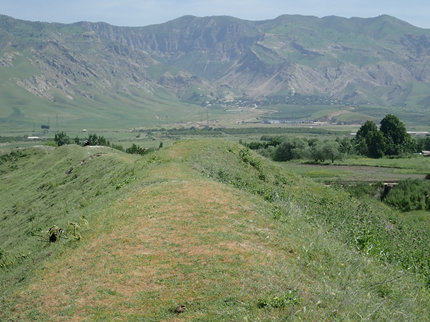
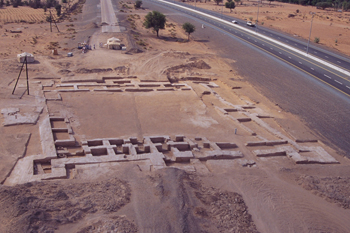
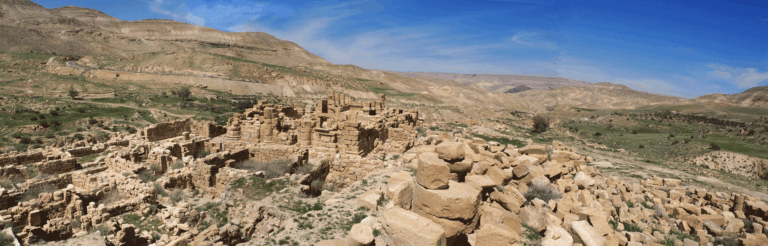
As part of the French Archaeological Mission in Jawf-Hadramawt, Michel Mouton’s work focuses on the territory of the South Arabian site of Makaynun (Hadramawt). This site, occupied from at least the second half of the 2nd millennium until the beginning of our era, is part of an agricultural landscape developed over the centuries from complex floodwater diversion systems.
Surveys conducted in the Hadramawt valley, around the site, and in the tributary valleys that make up the territory of the ancient community revealed a considerable set of remains.
They bear witness to the evolution of water networks, ranging from small lower-slope installations to the construction of vast systems extending over several kilometers.
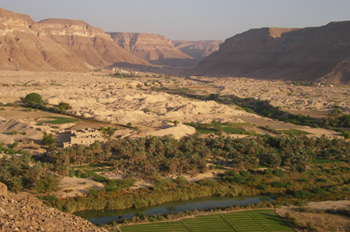
The settlement appears to have gradually concentrated in the central valley. There, the development of a central site was not accompanied by the abandonment of scattered villages; on the contrary, it coexisted with them, likely because it brought together community religious and political functions.
The distribution of sanctuaries all around the valley and near the villages, as well as cemeteries on the cliffs overlooking the inhabited area, creates a sacred geography that reflects the desire to place the space of the living under the protection of deities and ancestors.
Bibliography :
- BENOIST A., LAVIGNE O., MOUTON. M. & SCHIETTECATTE J. (2007), Chronologie et évolution de l’architecture à Makaynûn : la formation d’un centre urbain à l’époque sudarabique dans le Hadramawt”, Proceedings of the Seminar for Arabian Studies vol. 37, p. 17-35.
- MOUTON M. (s. p.), L’eau en partage : territorialité, réseaux d’irrigation et formation des sociétés antiques dans les basses-terres du Yemen, in M. Dbyat & M. Mouton eds. Stratégies d’acquisition de l’eau et société au Moyen-Orient depuis l’Antiquité : études de cas, IFPO, Beyrouth, p. 8-23.
- MOUTON M. (s. p.), Makaynun and its territory : the formation of an urban centre during the South Arabian period in the Hadramawt, in Proceedings of the 17th International Congress of Classical Archaeology, Rome 22-26 september 2008.