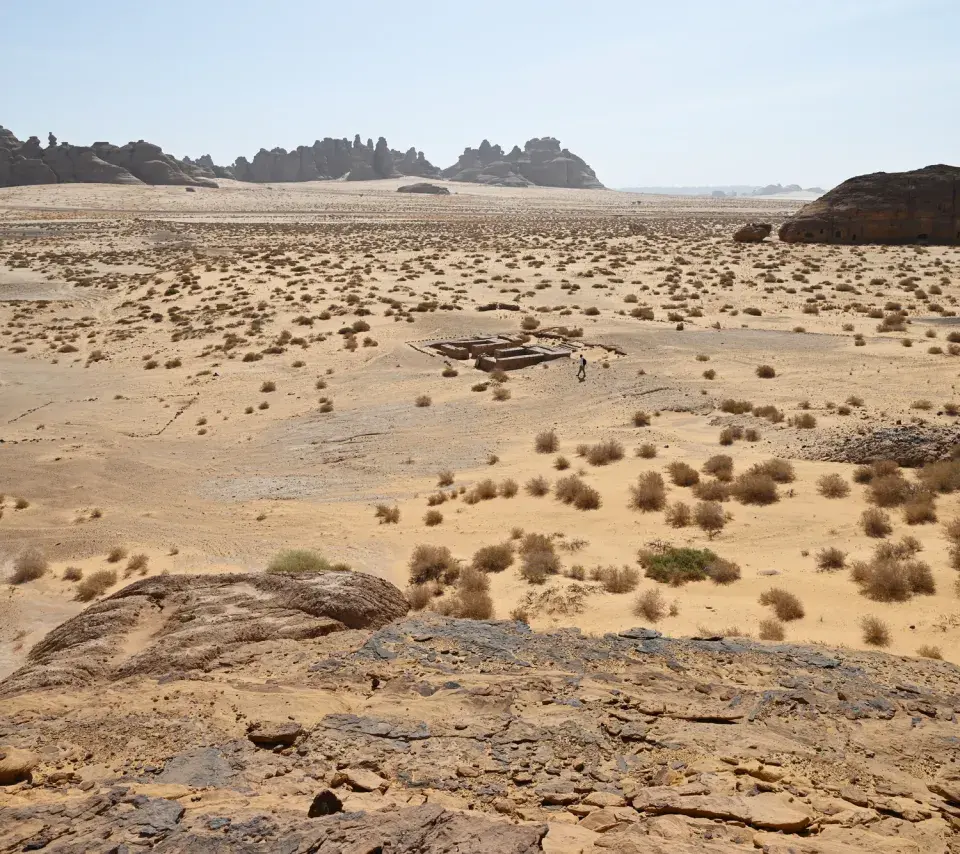
Hegra Archaeological Project (HAP)

The Hegra Archaeological Project (HAP) is a project co-directed by Abdullah Basonbol, professor at King Saud University, and Pauline Piraud-Fournet, researcher at the Jaussen & Savignac Archaeological Research Center of Paris 1 University.

The HAP is conducting multidisciplinary research until 2028 aimed at shedding light on the history of the Hegra – Madāʾin Ṣāliḥ site in Saudi Arabia.

It is supported by the Royal Commission for AlUla (RCU) and the French Agency for the Development of AlUla (AFALULA).
Publications similaires

  • South Syria

    Persons in charge: P.-M. Blanc (UMR 7041), J.-M. Dentzer † (member of the Institute), F. Braemer (UMR 6130). Participants of the UMR :J. Bruant, C. Casasoprana, P. Clauss-Balty, C. Delplace, J. Dentzer-Feydy, R. Douaud, C. Durand, O. Dussart, D. Gazagne, Y. Guichard, S. Harlé, M. Kalos, O. Labat, A. al-Mukdad, F. Renel, J. Rohmer, M….

  • Greco-Bactrian sites

    Excavation and Research program The Archaeological Mission of Southern Tajikistan conducted fieldwork at Takht-i Sangin, located in the southern part of the country on the right bank of the Amu Darya in 2015 and 2017. In 2016 and 2019, the mission carried out surveys in several valleys (Kafirnigan, Vakhsh, Tayr-su, Yakh-su) and the surrounding area…

  • The city of Shabwa in Hadhramawt

    The years 2003-2004 were mainly devoted to the publication of our research in Yemen. Indeed, since the excavations at Shabwa could not continue – for reasons beyond our control – it quickly became necessary to start publishing them. Initially, the manuscript for the fourth volume of the Shabwa Excavations was completely revised and then sent…

  • Bosra

    Starting in 1981, the French archaeological mission in southern Syria participated in the exploration of ancient Bosra. The research focused on understanding urban planning, through city-wide surveys, as well as particular monuments, and several archaeological excavations were carried out, allowing for the establishment of a detailed chronology of observed phenomena, especially for the Nabataean, Roman,…

  • Cyrrhus: Study of the Citadel

    the archaeological site The site of Cyrrhus-Nebi Houri is located near the Syrian-Turkish border. The city, covering nearly 65 hectares and the capital of Cyrrhestica, was founded by Seleucus I and then successively occupied during the Roman, Byzantine, and Islamic periods. Its location on the main routes leading from Antioch to the Euphrates or towards…