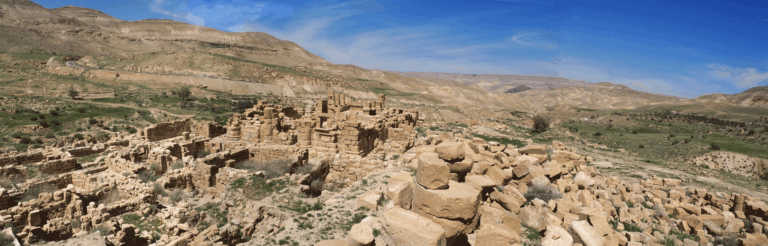
The Farasan Islands and the Red Sea
The OrAM team has been working since the early 2000s on the Farasan Islands archipelago, located in Saudi Arabia, 40 km from the coast and not far from the Yemeni border. The discovery of a Latin inscription, dated to 144 AD and mentioning the ancient name of the archipelago, Ferresan, led to several publications by Fr. Villeneuve (including one with C.S. Phillips and W. Facey, the discoverers of the inscription). The immense significance of this text, which attests to a Roman military presence previously entirely unknown, justified organizing on-site surveys in 2005 and 2006. A second, fragmentary Latin text was discovered, as well as numerous artifacts preserved in private museums on the main island (notably with M. I. Miftah).
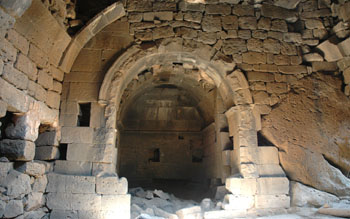
Many sites, mostly previously unknown, have been documented with the help of local scholars and the local representative of the Saudi Commission for Tourism and National Heritage (SCTH), A. al-Aqīli. Several appear to be linked, in particular, to the presence of the Roman military, as evidenced by the first Latin inscription, and to maritime trade in the early centuries of the Christian era (finely cut monumental block architecture, Dressel 2-4 amphorae, probable Nabataean shards). Others consist of constructions with rough block architecture comparable to that of known sites on the mainland, particularly in the Jizān region.
The surveys also make it possible to highlight several South Arabian inscriptions, the first of which were published by C.S. Phillips and S. Marion de Procé. In 2011, a final survey mission on the archipelago allowed for the completion of observations, particularly on ceramics and epigraphic remains, and for the recording of new sites.
Following this, two additional missions were organized in 2013 and 2014 thanks to the logistical and financial support of the APOHR team, and the financial support of the Institut Universitaire de France, the CEFAS, and the Cooperation and Cultural Action Service of the French Embassy in Riyadh. The mission also benefited from the Paule Dumesnil Prize from the Académie des Inscriptions et Belles-Lettres to continue its work.
In 2013, the mission led by Fr. Villeneuve was made up of P.-M. Blanc, S. Marion de Procé (OrAM team), and B. Riba (IFPO). The site chosen to start this two-year program is Wādī Maṭar, a clay valley in the south of the main island of the archipelago.
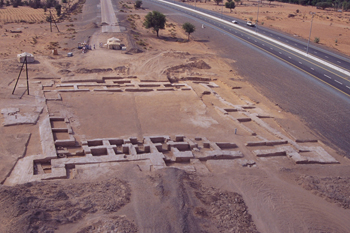
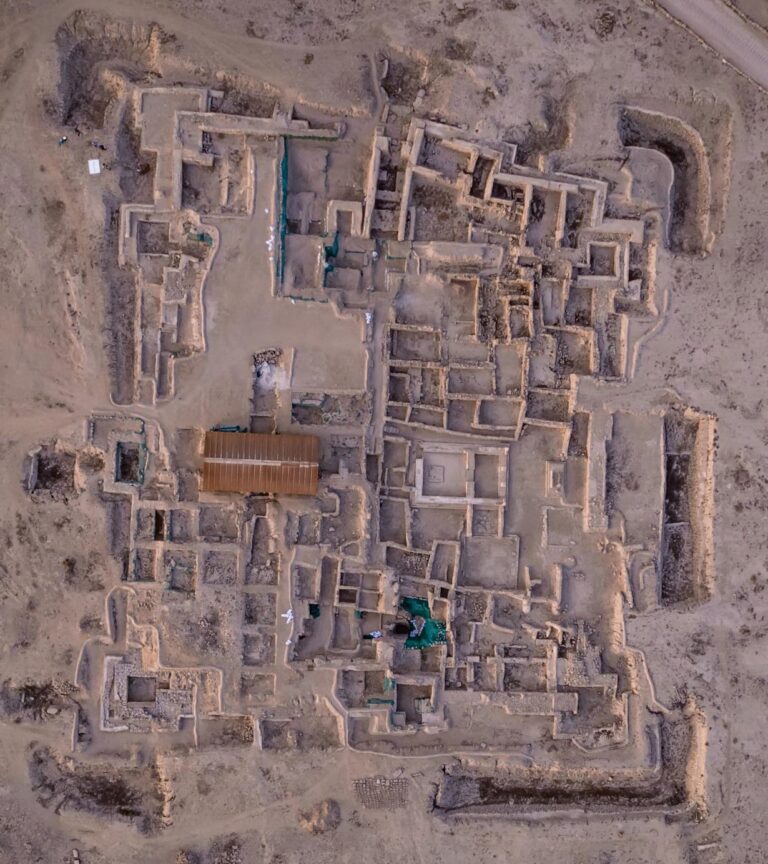
Numerous micro-sites make up this complex, characterized by local dry stone architecture. The team then focused its efforts on surveying the site called Wādī Maṭar 2 and its three subunits A, B, and C.
At the end of the campaign, almost all of the sites were surveyed and cleaned up. Ensemble A is made up of about ten separate units, some of which are marked by metal slag in one case, by murex-type shells showing signs of consumption in another, or by a very high concentration of ceramic sherds. Ensemble B, densely built, went through several phases of development. The identification of large courtyards and the presence of monumental thresholds (the largest measuring 2 meters in width), whose jambs are inscribed with South Arabian letters, suggest that this is a public building. The last ensemble, called C, consists of a small rectangular, oriented sanctuary, located in the middle of an enclosure of upright stones, comparable to known examples in the Yemeni Tihāma (al-Ḥamid) and on the Ethiopian plateaus (Gobochela).
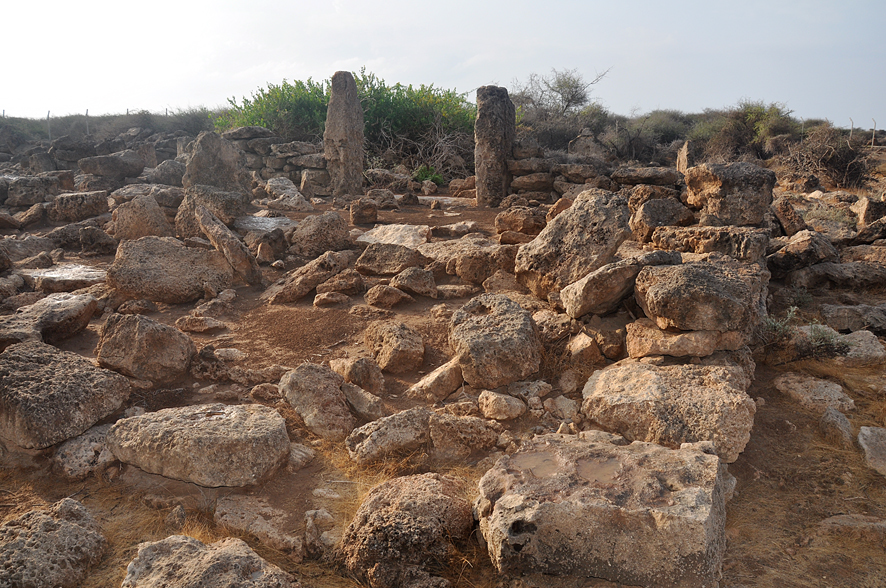
In 2014, the study of Wādī Maṭar continued with the excavation of the small sanctuary C carried out by Fr. Villeneuve, P.-M. Blanc, C.S. Phillips, and S. Marion de Procé. This work helped clarify the entrance arrangement (axial staircase), identify demolition levels (collapse layers in front of the west façade), and date the last phase of occupation. The discovery of fragments of Roman and South Arabian amphorae during the excavations, along with fragments of calcite bull statuettes, dates the abandonment of the site to the early centuries of the Christian era. The architecture, the presence on the surface of South Arabian sherds from the beginning of the 1st millennium BCE, and the inscriptions discovered in Wādī Maṭar, however, confirm that the site was occupied from the beginning of the South Arabian period. Continuing the excavations may reveal layers from this period, but the natural rock is close to the current surface and possibly involves the destruction of ancient stratigraphic layers.
During the 2014 mission, the team also went to the north of the main island to a site previously visited in 2011 for a few days of rescue excavation. The site consists of three neighboring necropolises, one of which had been heavily looted, justifying a rescue operation.
The presence of a geomatician (G. Davtian, CEPAM) in the team allowed for the recording of topographic data and the taking of aerial photographs using a kite. Finally, a geomorphologist was also involved to locate the coastline, which is currently 3 km from the site, during the periods of occupation of Wādī Maṭar (early 1st millennium BC and the first centuries of the Christian era).
The Wādī Maṭar is rich in remains whose functions, relationships, and purpose still need to be understood. The initial results are very encouraging and help shed light on local communities that came into contact with external populations.
These preliminary studies allow for the consideration of a more extensive research program, now led by S. Marion de Procé.
Bibliography :
VILLENEUVE F. 2004, « Une inscription latine sur l’archipel Farasân, Arabie Séoudite, Sud de la mer Rouge », Comptes rendus de l’Académie des Inscriptions et Belles-Lettres, p. 419-429.
VILLENEUVE F. 2007, « L’armée romaine en mer Rouge aux IIe-IIIe siècles après J.-C. : à propos des inscriptions de Farasân », dans Lewin A. (éd.), Actes du colloque L’esercito romano tardo-antico nel Vicino Oriente, Universita della Basilicate, Potenza-Matera, 12-15 mai 2005, Oxford, 2007, p. 13-27 .
VILLENEUVE F. 2007, « Farasan Latin inscriptions and Bukharin’s ideas : no pontifex Herculis ! and other comments », Arabia, 4, 2007, p. 289-296.
VILLENEUVE F., 2008 (en arabe) « Deux inscriptions militaires latines découvertes aux îles Farasan (mer Rouge méridionale, Arabie saoudite). Rome, Alexandrie, Pétra et le commerce oriental au IIe siècle après J.-C. », dans Actes du colloque The City in the Arab World in Light of Archaeological Discoveries, Sakaka, 5-7 décembre 2005, Riyadh, 2008, p. 167-180.
S. MARION DE PROCÉ et C.S. PHILLIPS 2010 , « South Arabic inscriptions from the Farasân Islands (Saudi Arabia) », Proceedings of the Seminar for Arabian Studies 40, 2010, p. 277-281.
S. MARION DE PROCÉ 2010, « Histoire de l’archipel des îles Farasān (Arabie Saoudite)”, Archéothéma 9, juillet-août 2010, p. 42-43.
S. MARION DE PROCÉ 2017, « The Farasān Archipelago in the Red Sea Context: the Archaeological Evidence », dans D. Agius et al. (éds.) Human Interaction with the Environment in the Red Sea, Brill, 2017.