Colloque | Jemdet Nasr des 2 au 4 juin 2026
2-4 juin 2026
Institut National d’Histoire de l’Art
Jullian Room,
Galerie Colbert, 2 rue Vivienne
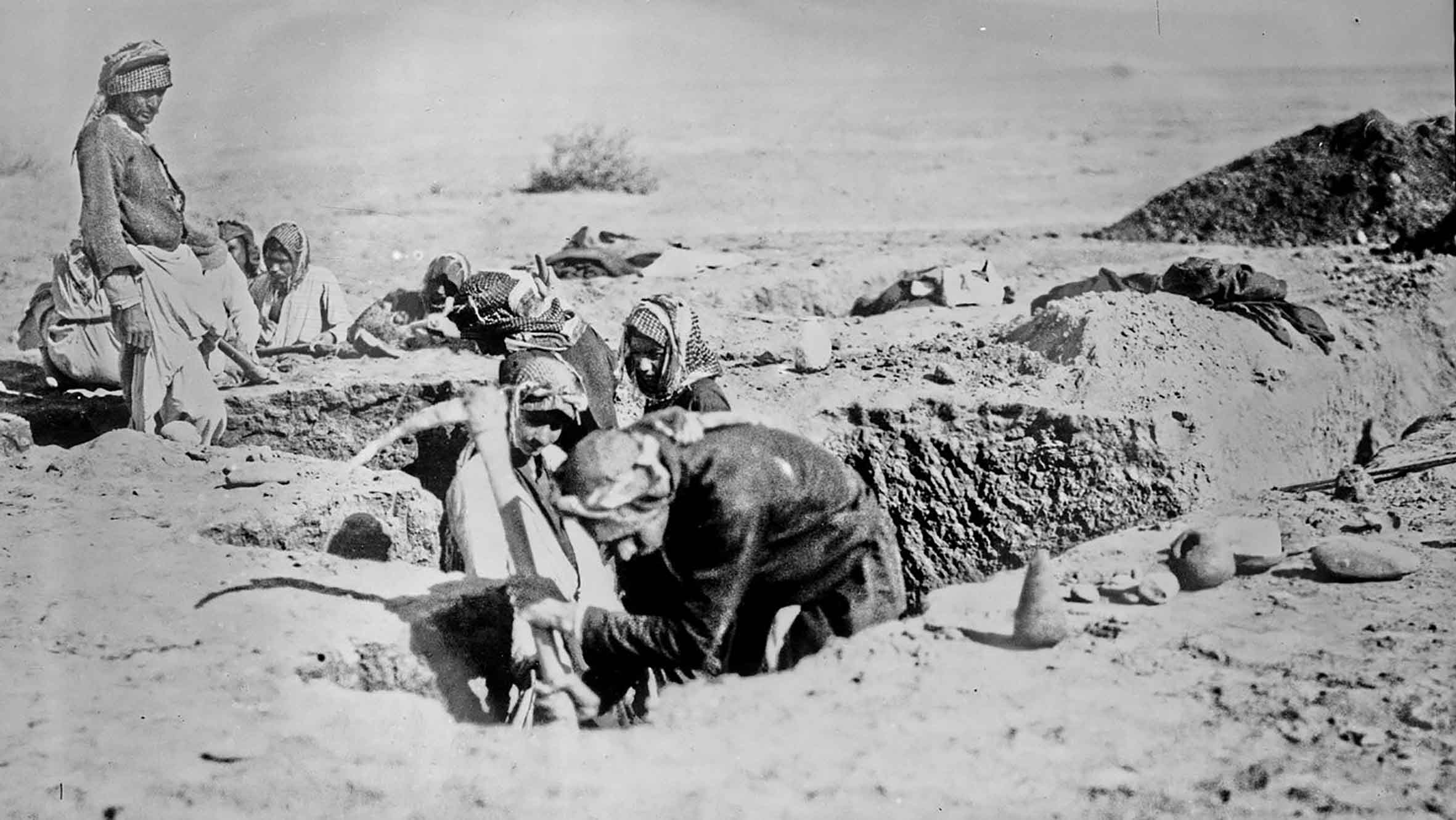
Le colloque international « Jemdet Nasr 1926-2026 : A Century of Investigation and Research » (JN100) se tiendra du 2 au 4 juin 2026 à Paris, à l’Institut national d’histoire de l’art (INHA). Il marquera le centenaire des premières fouilles conduites sur le site de Jemdet Nasr. Situé à quelques dizaines de kilomètres au sud de Bagdad, ce site de dimensions modestes a livré des découvertes majeures qui lui ont assuré une place déterminante dans l’histoire du Proche-Orient ancien. Il a donné son nom à une période charnière (vers 3250-2900 av. notre ère), marquée par l’émergence des premières formes d’écriture et l’essor des cités-États, à l’aube de l’histoire.
Alors que l’étude de cette époque décisive de l’histoire mésopotamienne est restée relativement en suspens depuis les campagnes de fouilles menées par Roger Matthews en 1988-1989, et plus encore depuis le colloque de Tübingen en 1983, le colloque de Paris 2026 offrira une occasion décisive de renouveler et de relancer les recherches sur cette période.
Réunissant une grande partie de la communauté scientifique internationale travaillant sur cette époque, l’événement accueillera vingt-trois communications portant sur le site de Jemdet Nasr lui-même, la transition entre les IVe et IIIe millénaires, principalement en Mésopotamie du Sud mais aussi dans les régions environnantes, les traditions glyptiques, les pratiques écrites, ainsi que les nouveaux travaux de terrain.
Événement public en accès libre, uniquement en présentiel.
Programme du colloque en anglais
1st Day : Mardi 02 juin 2026
14h00–14h10
Introduction
Session 1 – Jemdet Nasr: The Site
Chair: Camille Lecompte (CNRS, ArScAn) & Hugo Naccaro (Université Paris 1 Panthéon-Sorbonne, Jaussen & Savignac, ArScAn)
14h10–14h40
Roger Matthews (University of Reading)
Jemdet Nasr: Excavations and Outcomes of the 1920s and 1980s Seasons
14h40–15h10
Nancy Highcock (Ashmolean Museum)
“This section is developing into a predominantly Mesopotamian one”: Jemdet Nasr and the search for the ‘Early Sumerian Copper Age’ at a time of transition for the Ashmolean Museum
15h10–15h40
David Mudd (University of Reading)
Lithics from Jemdet Nasr
Break
Session 2 – Transition between the 4th and 3rd millennia BCE in Southern
Mesopotamia
Chair: Pascal Butterlin (Université Paris 1 Panthéon-Sorbonne, ArScAn)
16h00–16h30
Hugo Naccaro (Université Paris 1 Panthéon-Sorbonne, Jaussen & Savignac, ArScAn)
The Jemdet Nasr Period: Dawn of the Sumerian City-State
16h30–17h00
Cale Johnson (Freie Universität Berlin)
The ‘Second Dozen’ and the Subalterns: ArO 13–24 and Late Uruk Local Bureaucracies
17h00–17h30
Margarete van Ess (Deutsches Archäologisches Institut)
Developments in Pottery technology: Vessels from Uruk IV, III and I Eanna in Uruk
17h30–18h00
Discussion
2nd Day – Wednesday 3rd June
9h00
Coffee
Session 3 – Jemdet Nasr Period: Views from Outside
Chair: Benjamin Mutin (Sorbonne Université, Orient & Méditerranée)
9h30–10h00
Steve Renette (University of Cambridge)
The ‘Jemdet Nasr’ Period East of the Tigris: Separated Regionalisation or Interlocking Interaction Spheres?
10h00–10h30
Michael Lewis (Universidade de Coimbra)
A View from the North: Some Preliminary Thoughts on the Post-Uruk Ceramic Assemblage from Kani Shaie, Iraqi Kurdistan
10h30–11h00
Sara Quaggio (University of Pisa)
Reassessing the Jemdet Nasr Horizon: Ceramic Evidence and Regional Dynamics from Central and Southern Mesopotamia towards Magan
Break
11h30–12h00
Jacob Dahl (University of Oxford)
Uruk and Jemdet Nasr: a View from Susa
12h00–12h30
Holly Pittman (University of Pennsylvania, Penn Museum)
The Long Jemdet Nasr Period: A View from the Periphery through the Lens of Glyptic
12h30–13h00
Discussion
Lunch
Session 4 – Jemdet Nasr Tradition: Writing, Sealings
Chair: Jean-Jacques Glassner (CNRS)
14h30–15h00
Clélia Paladre (Musée du Louvre, ArScAn)
Material Ambiguities in Proto-Elamite Administration: Perforated and Lenticular Tablets from Susa
15h00–15h30
Massimo Maiocchi (Università Ca’ Foscari Venezia)
Early Scribal Culture and the Problem of Diffusion
15h30–16h00
Amy Richardson (University of Reading)
States of Clay: scientific approaches to the bureaucratic corpus
Break
16h30–17h00
Vitali Bartash (Universität Münster)
Ritual, Resources and the Making of the City-State: Urban–Rural Networks in Early Dynastic Mesopotamia c. 2900 BC through the Nippur Feast Tablet
17h00–17h30
Camille Lecompte (CNRS, ArScAn)
An Overview of the Jemdet Nasr Textual Corpus and Its Provenance
17h30–18h00
Discussion
18h10-19h30
Cocktail – Institut National d’Histoire de l’Art
3rd Day – Thursday 4th June
9h00
Coffee
Session 5 – Unearthing the Jemdet Nasr World: Current Approaches and Fieldwork
Chair: Clélia Paladre (Musée du Louvre, ArScAn)
9h30–10h00
Jaafar Jotheri (University of Al-Qadisiyah)
Water Management in the Jemdet Nasr Period: Insights from Recent Discoveries
10h00–10h30
Sidonia Obreja (Université Paris 1 Panthéon-Sorbonne, SPHINX, ArScAn) & Amaury Havé (University College London, ArScAn)
Shadows of Rivers and Monuments: Results from the First Survey Season at Umm el-Ajjaj
10h30–11h00
Melania Zingarello (CNRS, CEPAM) & Johnny S. Baldi (CNRS, Archéorient)
Beyond Ur. Investigating Early Urban Growth and Townscape at Rejibah
Break
Session 6 – Unearthing the Jemdet Nasr World: Old Sites and New Data
Chair: Philippe Quenet (Université de Strasbourg, ArcHiMèdE)
11h30–12h00
Ivana Puljiz (Universität Freiburg) & Peter Pfälzner (Universität Tübingen)
Looking for a needle in a haystack – The hidden Jemdet Nasr period at Kish and the
question of the origin of a major Early Dynastic city state
12h00–12h30
Adelheid Otto (Ludwig-Maximilians-Universität München)
Fara-Šuruppak in the Jemdet Nasr period: New results
Lunch
14h00–14h30
Jacob Jawdat (Ludwig-Maximilians-Universität München)
The Settlement Patterns in the Fara-Šuruppak Region Revisited: From the Uruk to the
Jemdet Nasr Period
14h30–15h00
Davide Nadali (Università La Sapienza) & Luca Volpi (Universidad Autónoma de Madrid)
Jemdet Nasr from the Lagash Region: The Archaeological Evidence at Ancient Nigin
15h00–15h30
General Discussion – Conclusions
Organisation
Hugo Naccaro (Université Paris 1 Panthéon-Sorbonne, Jaussen & Savignac, ArScAn);
Camille Lecompte (CNRS, ArScAn)
Roger Matthews (University of Reading)