Failaka-Ikaros: excavation and research program
The Hellenistic establishment
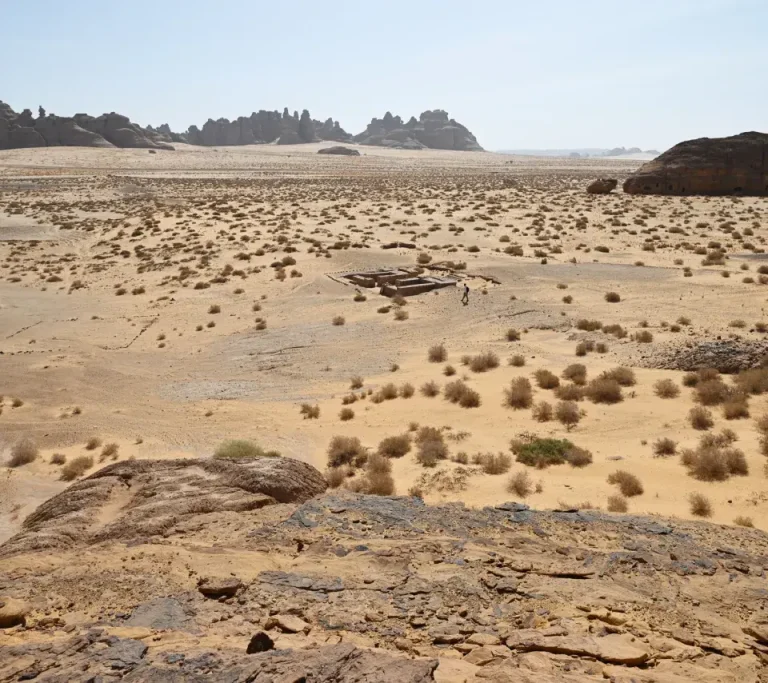
Failaka Island, located in the Arabian-Persian Gulf 20 km off the north-eastern coast of Kuwait City, lies on the maritime route connecting Mesopotamia to the Indian Ocean, between the Mesopotamian, Arab, Persian, and Indian worlds. Its fresh water resources have allowed the settlement of early populations from the Middle Bronze Age to the present: no fewer than sixteen archaeological sites have been identified on the island since 1958 and are studied by international teams.
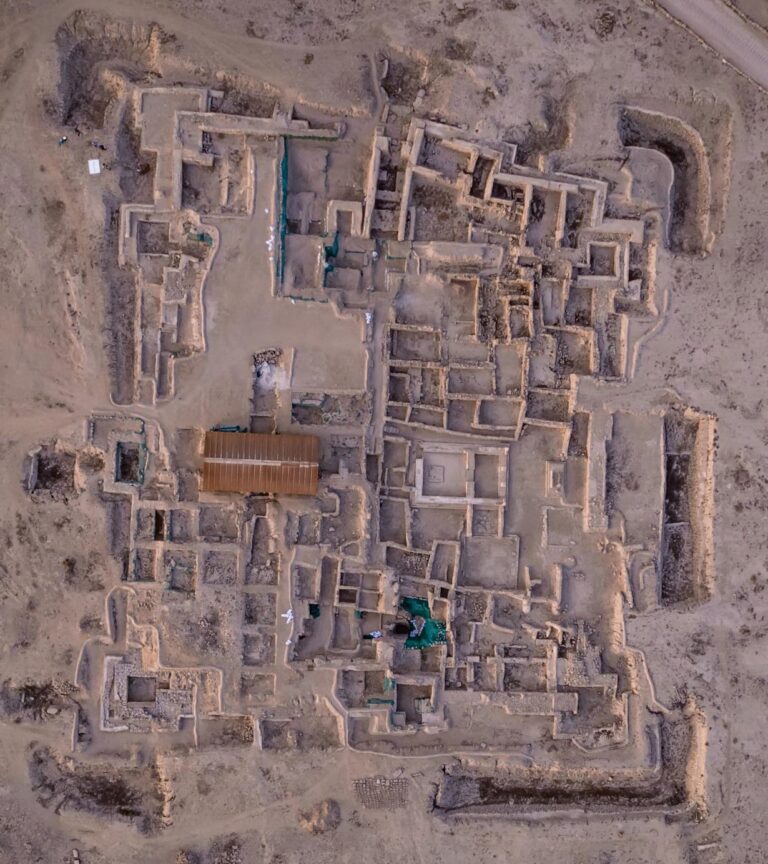
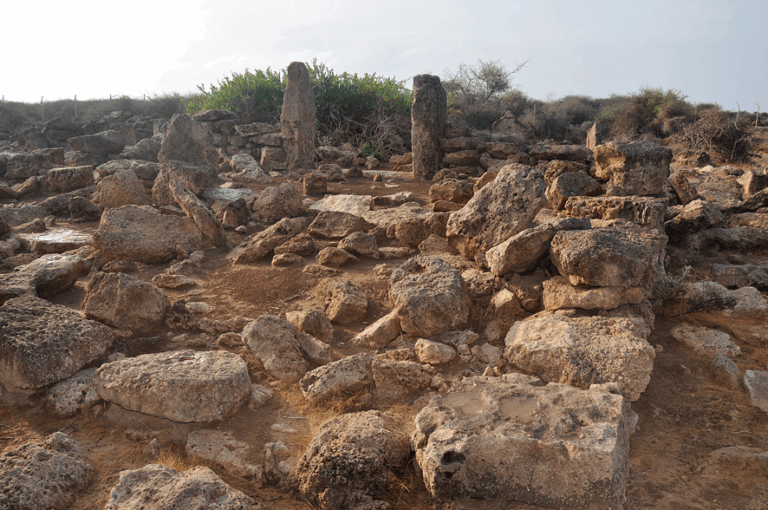
During the Hellenistic period, the island was called Ikaros which, according to Arrian, was named by Alexander the Great. At Tell Khazneh, 600 m north of the southern coast, an Achaemenid sanctuary was reoccupied in the Hellenistic period, around the late 4th century BCE. The Seleucids quickly exploited the island’s strategic position, establishing a fortress at the end of 4th-beginning of 3rd centuries BCE, mainly under the reign of Antiochus I (281-261) as dated by the previous French mission. The settlement lasted until around the beginning of the 1st century BCE, probably under Characene rule. Outside the walls, it also included a temple of Artemis and a large building called the Terracotta Workshop, where numerous moulds of terracotta figurines were discovered. All the buildings, except for Temple A within the fortress, were constructed using foundations of small rubble stones bound with earth, supporting elevations made of mud bricks or small stones. But it was the entire island that constituted the territory of the occupants of the fortress and the villages that were established there at different times: in 2025, the Kuwaiti-Italian mission discovered a 1st century BCE building at Qurainiyah, on the northern coast of the island, and the Kuwaiti-Slovak mission had uncovered occupation layers from 50 to 400 CE in Al-Khidr, at the northwest tip of the island. In these two locations, it is reasonable to reconstruct ports and villages, particularly those involved in fishing and farming on the island.
The fortress
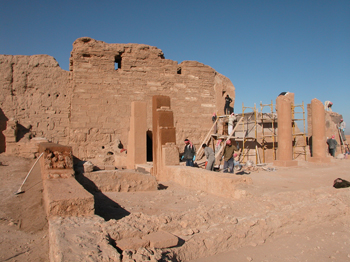
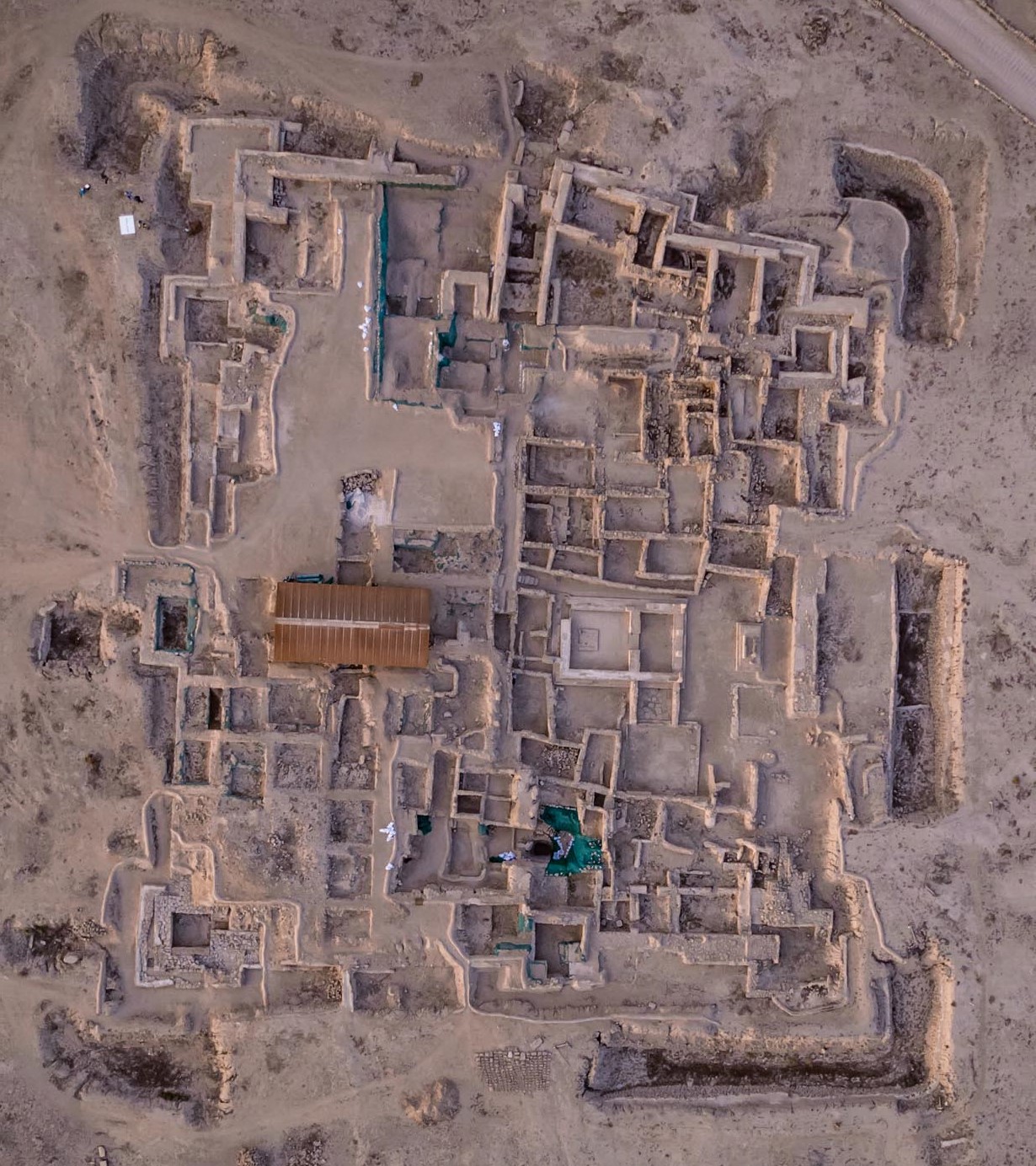
From the very first period, in addition to its ramparts, the fortress included two temples, the larger of which (temple A) was characteristic of Greek architecture while incorporating more eastern elements, notably decorative features copying Achaemenid column bases. Our research has linked at least one well to the early stages of the fortress.


We have also modified the chronological distribution of some of the constructions across the six periods of the site’s existence and, in particular, have refined the phasing thanks to a detailed study of the stratigraphy and architecture coupled with construction techniques. We have uncovered various states reflecting alternations of abandonment, repairs and expansions of the fortifications with a ditch protecting the whole, or narrowing of the circulation path. This evolution of the ramparts shows that, over a relatively short period of time, the fortress and its defense systems were subject to significant activity, bearing witness to the intense life of the communities that succeeded one another. Towards the end of its existence, the military aspect of the stronghold finally disappeared in favor of a densely populated village. We can thus reconstruct a second period that saw the abandonment of the fortifications and the establishment of a village, then, during a third period the Seleucid power retook the island, enlarging the fortress and restoring its defenses. A fourth period was characterised by abandonment, before the re-establishment of a densely populated village in the fifth period, around the 1st century BCE, followed by its final abandonment in the sixth period. The site has not been reoccupied.
The Failaka-Ikaros mission (created at the end of 2023) is conducting operations to refine the chronological sequence of the fortress’s stratigraphy, and new studies on the island of Ikaros are also taking place, including geophysical and funerary surveys and an extensive data digitisation program.
Finally, since 2011, we have been carrying out a program at the fortress to preserve all the remains unearthed over more than sixty years, but we have not had the opportunity to implement a long-term general plan. Until October 2023, we mainly carried out numerous emergency conservation operations. Various large scale material tests have been conducted to determine the most sustainable solutions that respect the remains, and these experiments are still ongoing. Since 2025, a new program led by the French-Kuwaiti Mission of Failaka-Ikaros has been underway with more substantial resources, which we hope to complete over the coming years. In particular, a project to apply for UNESCO World Heritage status for the island by Kuwait is currently in progress, in which we are participating (Failaka Island: A Palimpsest of Human Civilizations).
French-Kuwaiti and French archaeological missions
In November 2023, the French-Kuwaiti Archaeological Mission of Failaka-Ikaros (NCCAL-DAMK-ARSCAN) was established with the support of NCCAL, ARSCAN, CEFREPA, and the French Institute in Kuwait; it is headed, on the Kuwaiti side, by Dr. Al-Jassar (Secretary General of NCCAL) and on the French side by Dr M. Gelin (CNRS) and J.-M. Gelin. It brings together studies of the Hellenistic period in Failaka, covering both the settlement and the island.
The former FKAMF/French-Kuwaiti Archaeological Mission of Failaka was created in 2011 by Mr. Gelin and Sh. Shehab (Director of DAMK at NCCAL) with the support of IFPO, itself taking over the French mission led by J.-F. Salles and O. Callot (CNRS-MOM, 1983-2009). Its activity focused on the Hellenistic fortress and the medieval site of Al-Qusur. In July 2014, this mission was handed over to S. Duwish (DAMK), E. Kienle, and J. Bonnéric (IFPO); it was associated with CEFREPA from 2016 and continued in its original form until November 2023 .
There are now two French-Kuwaiti missions in Failaka, consisting of two separate operations (Ikaros and Al-Qusur), each focusing on different sites and periods.
Acronyms:
– NCCAL: National Council for Culture, Arts and Letters, Kuwait;
– DAMK: Department of Antiquities and Museums of Kuwait;
– ARSCAN: Research Centre Archéologies et Sciences de l’Antiquité, Nanterre;
– CNRS: French National Centre for Scientific Research;
– CEFREPA: French Centre of Reserach on Arabian peninsula;
– IFPO: French Institute for the Near-East;
– FKAMF: French-Kuwaiti Archaeological Mission of Failaka (MAFKF);
– MOM: Research Centre Maison de l’Orient et de la Méditerranée, Lyon.
French-Kuwaiti Archaeological Mission of Failaka-Ikaros (since Nov. 2023)
– Gelin Mathilde, archaeologist, CNRS (since 2023);
– Gelin Jean-Michel, archaeologist (since 2023);
– Aubrun Romain, stone cutter, mason (2025);
– Bombeau Valère, archaeologist (2025);
– Costa Laurent, archaeologist-data digitisation, CNRS, Deputy Director of ARSCAN (2025);
– Laguardia Marie, archaeologist-funeral archaeology (2025);
– Marillot Olivier, geographer (2025);
– Pessel Marc, geophysician, Paris-Saclay University (2025);
– Saintenoy Albane, geophysician, Paris-Saclay University (2025);
– Zeyen Herman, geophysician, Paris-Saclay University (2025).
FKAMF (from 2011 to 2023), participants Hellenistic establishment:
Field:
– Gelin Mathilde, archaeologist, CNRS (2007-2009, 2011-2018, oct. 2023);
– Abdul Massih Jeanine, archaeologist, Lebanese University (2012);
– Al-Shbib Shaker, archaeologist (2009);
– Al-Mutairi Hamed, aerial photography, DAMK (2013-2018);
– Baier Steffen, topographer (2012-2013);
– Bendakir Mahmoud, architect-site preservation (2012);
– Couturaud Barbara, archaeologist, IFPO (2012-2016);
– Deb Ahmad, archaeologist, Direction of Antiquities and Museums of Syria (2009);
– Devaux Emmanuelle, architect-site preservation (2013-2017);
– Gelin Jean-Michel, archaeologist (2009 ; 2011-2019; 2022-oct. 2023);
– Guichard Yves, aerial photography (2009);
– Humbert Jean, draftsman (2011-2018; 2023);
– Thomas Yohann, archaeologist, Inrap (2014).
Artefacts:
– Ala El-Dine Abdallah, ceramologist (2009, 2011-2012);
– Alami Sara, preservation (2012-2014);
– Bergès Elsa, coroplast (2019);
– Bernel François, preservation (2009-2012);
– David-Cuny Hélène, draftswoman (2012-2018);
– Durand Caroline, ceramologist (2014-2015);
– Houal Jean-Baptiste, ceramologist (2016-2018; 2023);
– Monchot Hervé, archaeozoologist (2016);
– Palme-Koufas Anna, draftswoman (figurines) (2017-2018).
Students:
– Boucard Jordan (2016);
– Contant Louise (2015-2016);
– Imbert Malika (2009);
– Khawam Rana (2013).
BIBLIOGRAPHY :
– Serie of the Danish mission: Ikaros. The Hellenistic Settlements, Aarhus, 1983-1989.
– Serie of the previous French mission (Bronze and Hellenistic periods) : Failaka. Fouilles françaises, Lyon, 1984-2008.
– Callot O., “Faïlaka à l’époque hellénistique”, L’Arabie préislamique, 1989, p. 127-144.
– Hannestad L., “Danish archaeological excavations on Failaka”, Arabie orientale, Mésopotamie et Iran méridional, de l’âge du Fer au début de la période islamique, Paris, 1984, p. 59-66.
– Hannestad L., “On the Periphery of the Seleucid Kingdom: Failaka Revisited”, New Perspectives in Seleucid History, Archaeology and Numismatics, Studies in Honor of Getzel M. Cohen, R. Oetjen ed., Berlin-Boston, De Gruyter, 2019, p. 312-332. https://doi.org/10.1515/9783110283846-019
– Galliano G. (éd.), L’île de Faïlaka, Archéologie du Koweït, Lyon, Musée des Beaux-Arts de Lyon/Somogy éditions d’art, 2005.
– Gelin M., “L’établissement d’Ikaros-Faïlaka au Koweït“, Bahreïn et ses voisins, Arabian Humanities 19, 2024 [en ligne]. https://journals.openedition.org/arabianhumanities/14357
– Gelin M., “Terre crue et archéologie: de la physique du matériau à la restauration de vestiges architecturaux”, éd. X. Faivre, Argiles. De la physique du matériau à l’expérimentation, Archaeopress, 2023, p. 43-56
– Gelin M., Gelin J.-M., Couturaud B., Houal J.-B., Monchot H., “The integration of the island of Ikaros into “international” and regional networks”, The spatiality of networks in the Red Sea and Western Indian Ocean, C. Durand, J. Marchand, B. Redon, P. Schneider éd., Lyon, MOM Éditions, 2022 http://books.openedition.org/momeditions/16386
– Gelin M. (dir.), Kuwaiti-French Expedition in Faïlaka. The Hellenistic Fortress (Tell Saïd). Preliminary Scientific Report 2009, Koweït, 2012. 128 p., ed. NCCAL. With contributions of Ala El Dine A., Deb A., Gelin. M., Gelin J.-M., Al Shbib Sh., Shehab Sh. https://hal.archives-ouvertes.fr/hal-03139002v2/document. Editd in Arabic language: 2009 عام الأولي التقرير .(سعيد تل) الهلنستية لحصن, لحصن الهلنستية (تل سعيد)ز التقرير الأولي عام, 2016, ed. NCCAL.
– Gelin M., “New French-Kuwaiti research in the Hellenistic fortress of Failaka-Ikaros”, Excavation and Progress Reports (8th International Congress on the Archaeology of the Ancient Near East 2), P. Bielinski, M. Gawlikowski, R. Kolinski, D. Lawecka, A. Soltysiak, Z. Wygnanska eds, Wiesbaden, 2014, p. 87-100. https://hal.archives-ouvertes.fr/hal-03035169/document
– Gelin M., « Conservation et mise en valeur du patrimoine archéologique au Proche-Orient : quelques réalisations de missions archéologiques », Journal of Historical, Philological and Cultural Studies 27-1, In honour of 75 years of Guennadi Andréïévitch Koshelenko, Académie des Sciences de Russie, Moscou-Magnitogorsk-Novossibirsk, 2010, p. 62-84, pl. 1. https://hal.archives-ouvertes.fr/hal-03010389/document
Scientific blogs:
– Gelin M., De retour de mission… Faïlaka au Koweït (5) : L’établissement hellénistique
– Gelin M., De retour de mission… Faïlaka au Koweït (4). L’établissement hellénistique
– Gelin M., De retour de mission… Faïlaka au Koweït (3)
– Gelin M., De retour de mission… Faïlaka au Koweït (2)
– Gelin M., De retour de mission… Faïlaka au Koweït (1)
– Gelin M., Histoire de la forteresse. Hypotheses, le carnet de la MAFKF
– Gelin M., Les recherches de la MAFKF. Hypotheses, le carnet de la MAFKF
– Gelin M., Culture matérielle et vie quotidienne. Hypotheses, le carnet de la MAFKF
– Devaux E., Préservation de la forteresse hellénistique de Faïlaka : premiers pas et solutions d’urgence. Hypotheses, le carnet de la MAFKF