South Syria
Persons in charge: P.-M. Blanc (UMR 7041), J.-M. Dentzer † (member of the Institute), F. Braemer (UMR 6130).
Participants of the UMR :
J. Bruant, C. Casasoprana, P. Clauss-Balty, C. Delplace, J. Dentzer-Feydy, R. Douaud, C. Durand, O. Dussart, D. Gazagne, Y. Guichard, S. Harlé, M. Kalos, O. Labat, A. al-Mukdad, F. Renel, J. Rohmer, M. Vallerin, S. Vatteoni, F. Villeneuve, E. Villeneuve-de Montlivault.
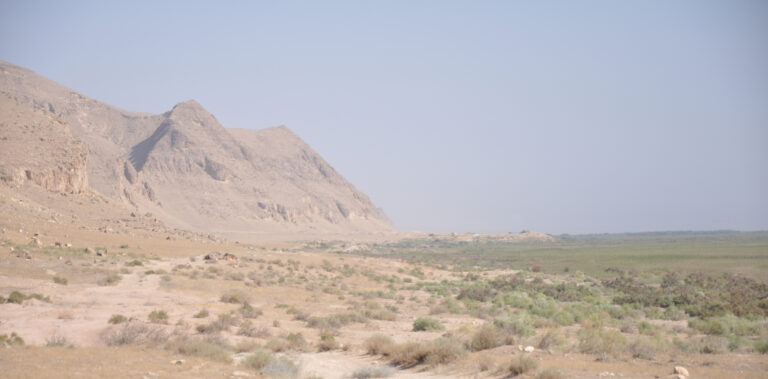
Southern Syria is the “founding” region of our team’s field activities and thematic focus. While our scope has broadened considerably since its inception, this region remains for our team the site of numerous archaeological activities, which are themselves evolving.
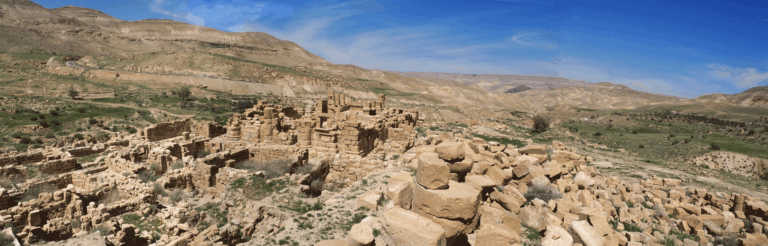
In the 1980s, the settlement had been surveyed and subject to a regional synthesis by F. Villeneuve. The rapid changes in the region’s demographics and urbanization over the past thirty years have led to the abandonment, ruin, or even deliberate destruction of previously remarkably well-preserved ancient settlements (more than 300 villages), which had supported the repopulation of the region from the 19th century onwards.
This situation justified the planning and funding of as comprehensive an investigation as possible of the ancient houses still preserved. Within the framework of the French-German-Syrian European program for the inventory of Syrian archaeological heritage (2002-2004), co-directed by J.-M. Dentzer, K.S. Freyberger (Deputy Director of the German Archaeological Institute in Rome), and the Directorate General of Antiquities and Museums of Syria, we were able to effectively resume the surveys and study of Romano-Byzantine housing in the villages of southern Syria, thanks to the presence at IFPO Damascus of P. Clauss-Balty, responsible for this program, and the architect E. Léna (in Damascus until 2006).
With the support of the IFPO and within the framework of the French Archaeological Mission in Southern Syria (dir. F. Braemer), these survey campaigns continued after the end of the European program.
A team effort was carried out in the field between 2002 and 2007, bringing together architects (E. Léna, L. Baqué, A. Ibrahim, D. Chahine, K. al-Balkhi), survey engineers from ESTP, a photographer (M. Balty), and French and Syrian archaeologists.
In addition to the village plans, the resulting corpus includes the plans, sections, elevations, and noteworthy details of the houses, accompanied by extensive photographic documentation. The missions from 2002 to 2004 focused on six ancient villages in Batanea and Auranitis (plains in the west and southwest of southern Syria), covering about thirty domestic complexes. In 2005, this series was supplemented by a similar survey of the ten preserved houses in the village of Nawa (slopes of the Golan), in 2006 by surveys (P. Piraud-Fournet, P. Dubœuf, and L. Baqué) in significant villages of Saccaea located north of Jebel al-Arab (Hayât, Hît, and Shaqqa-Maximianopolis), and in 2007 in a series of villages situated further south.
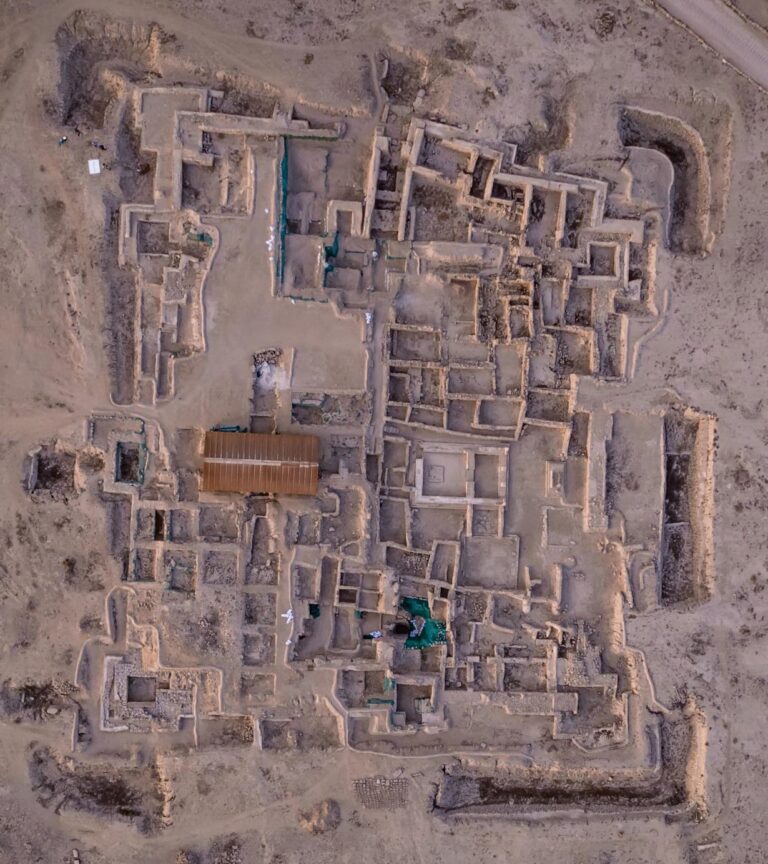
These initial campaigns led to the organization of a round table on the subject (2006, Paris I, Paris VII, CNRS, IFPO, Ministry of Foreign Affairs), followed by the publication in 2008 of a first book, *Housing in the Countryside of Southern Syria from the Bronze Age to the 15th Century* (P. Clauss-Balty ed., IFPO, Beirut). Assistance provided by sponsorship from Total and its subsidiary Total E&P Syria made it possible, starting in 2000, to study a complete village, Shâ‘ra, located at the northwest corner of the Leja, the ancient Trachonitis. The archaeological exploration of the site is now complete. Two field missions for the publication of the results took place in 2006 and 2007. Another important aspect of our recent activities in Southern Syria is the survey, devoted to the development and management of space from the end of the Iron Age to the Roman annexation (late 4th century BCE – 1st century CE).
Three survey campaigns, co-financed by the IFPO-French universities doctoral network, the French Mission in Southern Syria, and UMR 7041, have already made it possible to identify and document around 80 sites occupied during the Iron Age and the Hellenistic period, in the Léjâ area alone. A study of the survey material accompanies the field recordings, and all the results are integrated into a geographic information system (GIS). Expanding the survey to other areas of Southern Syria, since 2008, has already allowed for a better understanding of the cycles and patterns of human occupation throughout the region during these little-known periods.
The results obtained also shed new light on the scarce textual sources we have for these periods. These field missions are carried out jointly by J. Rohmer, D. Gazagne, F. Renel (INRAP), and H. Criaud (PhD, Paris I, ‘From Village to State’ team, UMR 7041: Settlements and Their Environment in the Bronze Age, in the Hauran and Jazira regions).
Our work on the Nabataean, Roman, and Byzantine city of Bosra, which is one of our main archaeological sites, has been primarily devoted to surveys, additional topographical work, and material studies in preparation for publications.
At the request of the archaeological authorities, we have also conducted archaeological or architectural assessments related to restoration projects.
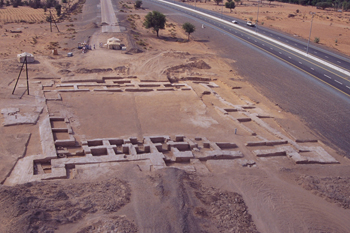
Under the direction of Pauline Piraud-Fournet (IFPO architect), an excavation is underway on the so-called “Palace of Trajan” located in the eastern part of the city and at the center of the large centrally-planned church (ANR Balnéorient program and French Archaeological Mission in Southern Syria).
As part of our ACI Cultures of Water in the Mediterranean East (2004-2007), in cooperation with the MSH of the MOM (UMR 5189, dir. M.-F. Boussac), we also focused during this period on studies of hydraulic techniques and water-related buildings in Southern Syria.