Khirbet adh-Dharih:The Nabataean Village and Sanctuary
Presentation of the mission and its objectives
The French-Jordanian archaeological mission of Dharih is a program of the UMR 7041 ArScAn of the French Ministry of Foreign Affairs and Ifpo; on the Jordanian side, mainly the Faculty of Archaeology and Anthropology of Yarmouk University, and the Department of Antiquities.
A strong collaboration with the University of Warsaw has been established to take care of the relatively late historical periods. The mission is co-directed by F. Villeneuve and Z. al-Muheisen. Here, in the pre-Roman and Roman periods, we are in the Nabataean world, about a hundred kilometers north of Petra, but in the countryside and on one of the two main north-south routes of the ancient Levant.
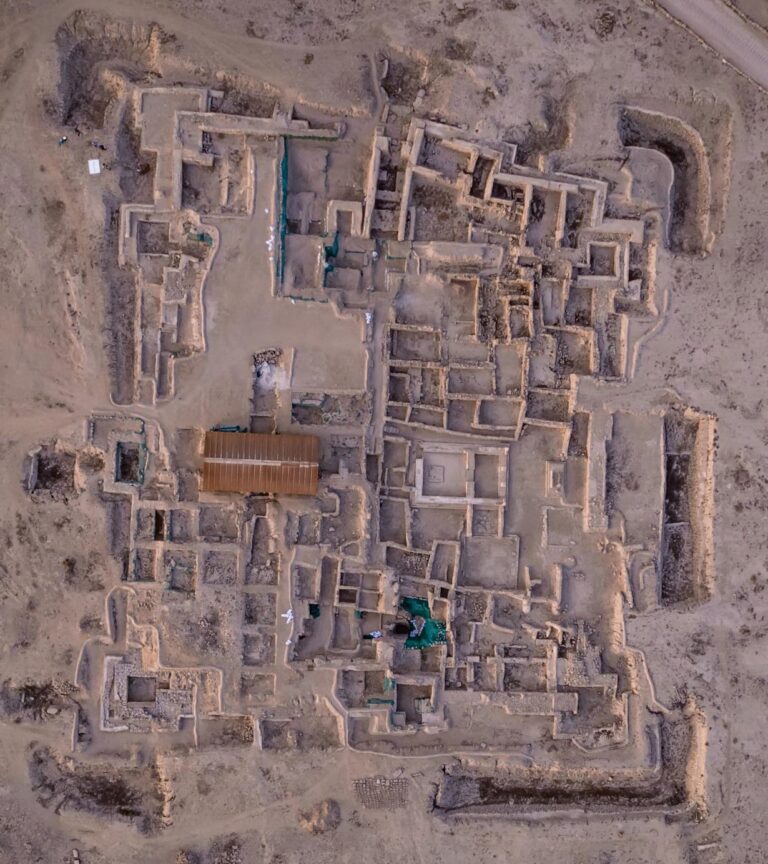
This program was initiated in 1983 on the advice of two prominent French scholars, Jean Starcky and Ernest Will, and a distinguished Jordanian archaeologist, Fawzi Zayadine. With 15 field campaigns up to 2013, and annual study campaigns (‘post-excavation’) at least until 2022, it aims to examine all components of a medium-sized site, 500 m in diameter (a rural settlement, but with a developed sanctuary and an important caravan stop):
- extensive excavations of the different components (temple and other elements of the sanctuary);
- peripheral elements of the sanctuary: district along the access road, compact building next to the sanctuary;
- rural houses and a ‘manorial residence’;
- oil presses;
- ordinary tombs and monumental tomb.
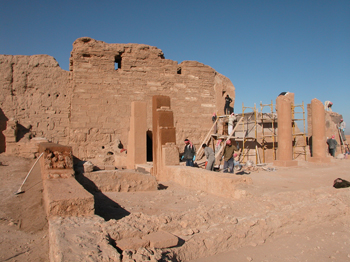
It also aimed to establish a complete chronological sequence for this site, whose monumental period is uniquely Nabataean and Nabataeo-Roman, but which has experienced several other important phases. The approach is particularly that of classical architectural archaeology and iconography, supplemented by systematic stratigraphic study, an extensive ceramics program on trade, environmental and archaeological-anthropological study, and more recently studies on Semitic inscriptions and graffiti, as well as widespread architectural conservation efforts, partial anastylosis, and measures for tourist development.
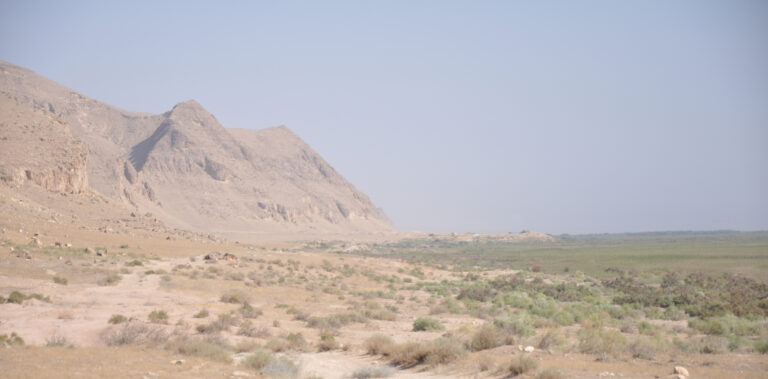
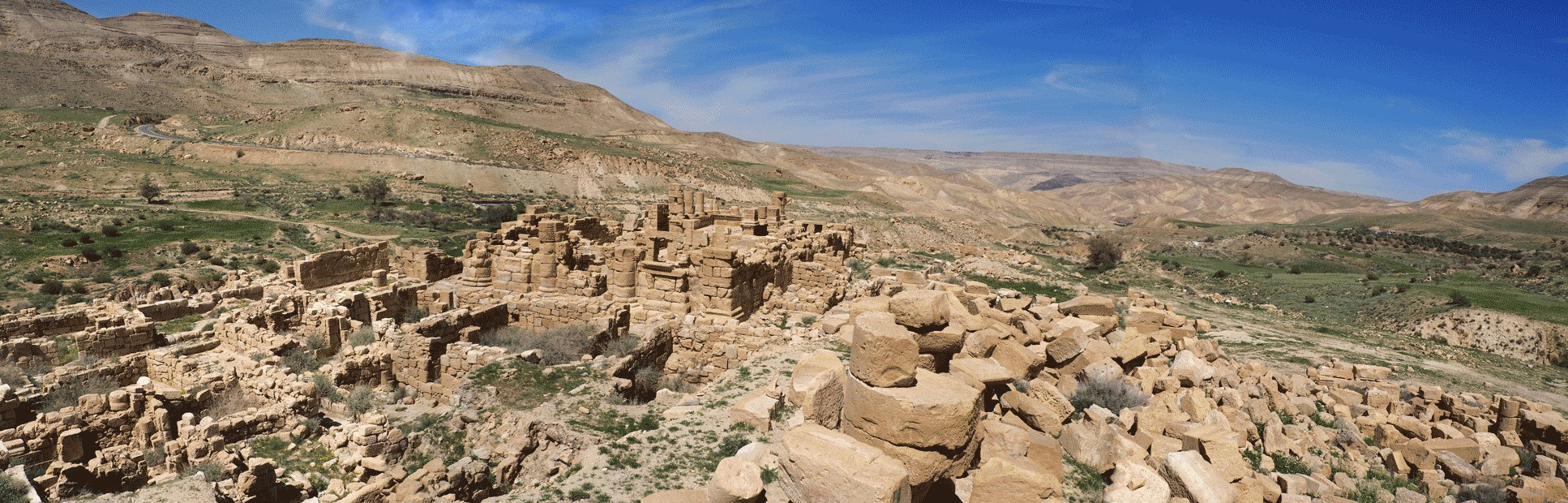
Dharih is indeed located in the beautiful Laaban Valley, very peaceful and untouched by modern constructions. Thanks to these efforts, Dharih (or the site) is now protected by a fence, maintained by the Jordanian Department of Antiquities, in fairly good architectural condition, and occasionally visited by local residents and tourist groups.
The benefits of the program
The Dharih program has produced results that serve as a provisional model for the phases of settlement and development in the southern inland Levant. There are interesting remains of protohistoric occupations: Neolithic with PNA pottery around 6150 BC; Early Bronze Age, mainly I and II (second half of the 4th millennium, beginning of the 3rd); Iron Age II (from the 8th-7th centuries) up to the early Hellenistic period.
But the main settled establishment only begins at the very end of the 1st century BC, or even at the beginning of the 1st century AD; it is provided from the start with a sanctuary, the creation of which is probably the reason for the establishment of a rural settlement.
A major quantitative and qualitative leap occurs around 100 AD, with the emergence of a large, highly decorated sanctuary with multiple courtyards, a structured settlement, and a cemetery (in both cases: a major monument attributable to the great family of the valley — probably that of the ‘chief of the Laaban spring,’ mentioned in an inscription of the nearby isolated and perched sanctuary of Tannour, dependent on Dharih —, and ordinary, undifferentiated constructions corresponding to the peasants).
This development was not created by the Roman annexation of 106 AD, but it was accelerated and reinforced by it. The growth continues throughout the 2nd century (for example, multiple works at the temple) and even at the beginning of the 3rd (addition of three banquet halls at the south entrance of the sanctuary).
A decline appeared from the middle and especially the end of the 3rd century: the disappearance of luxury Nabataean ceramics, the abandonment of a bathhouse and caravanserai area near the sanctuary’s access, followed by the dismantling of the three aforementioned banquet halls. Around 360 AD, everything was abandoned for nearly two centuries, possibly as a result of the very severe earthquake on May 19, 363, which shook the entire region.
A limited but dense reoccupation during the Byzantine and Umayyad periods took place between the 6th and 9th centuries. It was successively Christian, then Muslim (at least the domain’s master being Muslim, Hâshim ibn Shâbûr, curiously an Iranian on his father’s side). It was concentrated in the first and main courtyard of the former sanctuary and took the form of a hamlet made up of houses, workshops, such as an oil press, and a bath. The old temple was transformed into a church, and later into a residence in the time of Hâshim ibn Shâbûr (?).
The discovery of early Islamization at this rural site, as early as the end of the 7th century, is one of the surprising contributions of this program: it departs from a common pattern further north in present-day Jordan and Syria, where villages generally remained Christian for a long time. Finally, another peculiarity, though it is still unclear whether it represents a local exception to a nearly universal rule in rural Near Eastern regions or serves as a model in this area, ancient Edom, al-Jibâl since the Middle Ages: there is no evidence of village reoccupation during the Ayyubid and Mamluk periods in the 12th–15th centuries. On the other hand, somewhat earlier, a very modest settlement from the late Abbasid and Fatimid periods (10th–11th centuries) has been found here.
Bibliography :
Villeneuve F., 2011, « Dharih (Jordanie méridionale) : village chrétien puis musulman (vie-ixe siècles) dans les ruines d’un sanctuaire nabatéen », in Le Proche-Orient de Justinien aux Abbassides, Borrut A. et al. (éd.), Paris, p. 315-330.
Al-Muheisen M. et Piraud-Fournet P., 2013, « A large Nabataean-Roman period house at adh-Dharih », Studies in the History and Archaeology of Jordan XI, p. 833-846. https://halshs.archives-ouvertes.fr/halshs-00861999/PDF/Illustrations2013.pdf
Al-Muheisen Z. et Villeneuve F., 2008, « Le sanctuaire nabatéo-romain de Dharih (Jordanie) : nouvelles découvertes, 2001-2008 », Comptes rendus des séances de l’Académie des inscriptions et Belles-Lettres, p. 1496 – 1520. https://www.persee.fr/doc/crai_0065-0536_2008_num_152_4_92239
Al-Muheisen Z. et Villeneuve F., 2000, « Nouvelles recherches à Khirbet edh-Dharih (Jordanie du Sud), 1996–1999 », Comptes rendus des séances de l’Académie des inscriptions et Belles-Lettres, p. 1525 – 1563. https://www.persee.fr/doc/crai_0065-0536_2000_num_144_4_16232
Chambon, A., 2019, « Les enduits et le décor stuqué du temple nabatéo-romain de Dharih (Jordanie) », in Stucs d’Orient. Traditions orientales et cultures hellénisées, J. Dentzer-Feydy, A.-M. Guimier-Sorbets & C. Delplace (éd.). Syria Supplément V., Beyrouth, p. 141-162.
Chambon, A., Janif M., al-Muheisen Z. et Villeneuve F., 2002, Khirbet edh-Dharih : des Nabatéens au premier Islam, Amman.
Dentzer-Feydy, J., 2019, « Les stucs nabatéens : un aperçu », in Stucs d’Orient. Traditions orientales et cultures hellénisées, J. Dentzer-Feydy, A.-M. Guimier-Sorbets & C. Delplace (éd.). Syria Supplément V., Beyrouth, p. 81-104.
Durand C., Al-Muheisen Z., Piraud-Fournet P. et Tholbecq L., 2018, « A public bath-house, a caravanserai and a luxurious villa in Khirbat edh-Dharih (Tafileh, Jordan) », Annual of the Department of Archaeology of Jordan, 59, p. 607-622. http://publication.doa.gov.jo/uploads/publications/43/ADAJ_2018_59-607-622.pdf
Durand C. et Piraud-Fournet P., 2013, « Une huilerie des époques byzantine et omeyyade à Dharih. Matériel céramique. Fouilles de Dharih, V, 2 », Syria 90, p. 409-436. https://journals.openedition.org/syria/1940
Lenoble P., Augé C., Nehmé L. et Le Mort F., 2001, « Fouilles de Khirbet Edh-Dharih (Jordanie), I : le cimetière au sud du Wadi Sharheh », Syria 78, p. 89-151. https://www.persee.fr/doc/syria_0039-7946_2001_num_78_1_7729
Linant de Bellefonds, P., 2019, « Représentations anthropomorpjes et créatures hybrides dans le décor stuqué du temple nabatéo-romain de Dharih (Jordanie) », in Stucs d’Orient. Traditions orientales et cultures hellénisées, J. Dentzer-Feydy, A.-M. Guimier-Sorbets et C. Delplace (éd.). Syria Supplément V., Beyrouth, p. 163-170.
Linant de Bellefonds, P. et Villeneuve, F., 2014, « The Zodiac Reliefs on the Frieze of the Nabataean-Roman Temple at Dharih (Jordan) ». Aram 24, p. 343-377.
Piraud-Fournet P. et de Sédouy A., 2012, « Une huilerie des époques byzantine et omeyyade à Dharih, Description et fonctionnement. Fouilles de Dharih, V, 1 », Syria 89, p. 283-304. https://journals.openedition.org/syria/1400
Piraud-Fournet P. et Nehmé L., 2020, « House V12 in the Nabataean Village of Dharih. First Attempt to Interpret the Remains », Jordan Journal for History and Archaeology, Special Issue – Third International Conference on Petra and Nabataean Culture, R. Hunziker-Rodewald et I. N. Abuamoud (éd.), 14-4, p. 300-314. https://hal.archives-ouvertes.fr/hal-03499831/document
Seigneuret, D., 2011, « Dimension sociologique et restitution architecturale : l’exemple du temple nabatéo-romain de Dharih (Jordanie centrale) », Territoires, architecture et matériel au Levant, A. Le Bihan, P.-M. Blanc, F. Braemer, J. Dentzer-Feydy et F. Villeneuve (éd.). https://books.openedition.org/ifpo/2983?lang=fr
Seigneuret, D., 2018, « Entre influences et singularité : l’art religieux nabatéen de Dharih et de Tannur », Art et archéologie du Proche-Orient hellénistique et romain. Les circulations artistiques entre Orient et Occident, C. Arnould-Béhar et V. Vassal (dir.), Oxford (BAR), p. 105-114.
Villeneuve F., 1988, « Fouilles à Khirbet edh-Dharih (Jordanie), 1984-1987. Un village, son sanctuaire et sa nécropole aux époques nabatéenne et romaine (ier-ive siècles apr. J.-C.) », Comptes rendus des séances de l’Académie des inscriptions et Belles-Lettres, 132-2, p. 458-479. https://www.persee.fr/doc/crai_0065-0536_1988_num_132_2_14625
Villeneuve F., 1990, « The pottery from the oil-factory at Khirbet edh-Dharih (2nd century AD). A contribution to the study of the material culture of the Nabataeans », Aram 2, p. 367-384.
Villeneuve F. et al-Muheisen Z. 2000, « Nouvelles recherches à Khirbet edh-Dharih (Jordanie du Sud, 1996-1999) », Comptes rendus des séances de l’Académie des inscriptions et Belles-Lettres, 144-4, p. 1525-1563. https://www.persee.fr/doc/crai_0065-0536_2000_num_144_4_16232
Villeneuve, F. et Al-Muheisen Z., 2003, « Dharih and Tannur, Sanctuaries of Central Nabataea », in Petra Rediscovered. Lost City of the Nabataeans, G. Markoe (éd.), Londres, p. 82-100.
Villeneuve F. et al-Muheisen Z. 2008, « Le sanctuaire nabatéo-romain de Dharih (Jordanie) : nouvelles découvertes, 2001-2008 », Comptes rendus des séances de l’Académie des inscriptions et Belles-Lettres, 152-4, p. 1495-1520. https://www.persee.fr/doc/crai_0065-0536_2008_num_152_4_92239