Greco-Bactrian sites
Excavation and research program
The Archaeological Mission of Southern Tajikistan worked at the Takht-i Sangin site, located in the south of the country on the right bank of the Amu Darya in 2015 and 2017. In 2016 and 2019, it conducted surveys in several valleys (Kafirnigan, Vakhsh, Tayr-su, Yakh-su) and in the surroundings of Dushanbe.
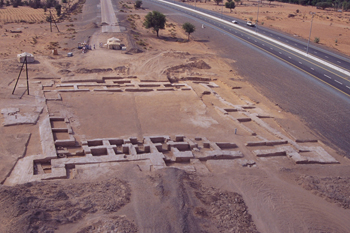
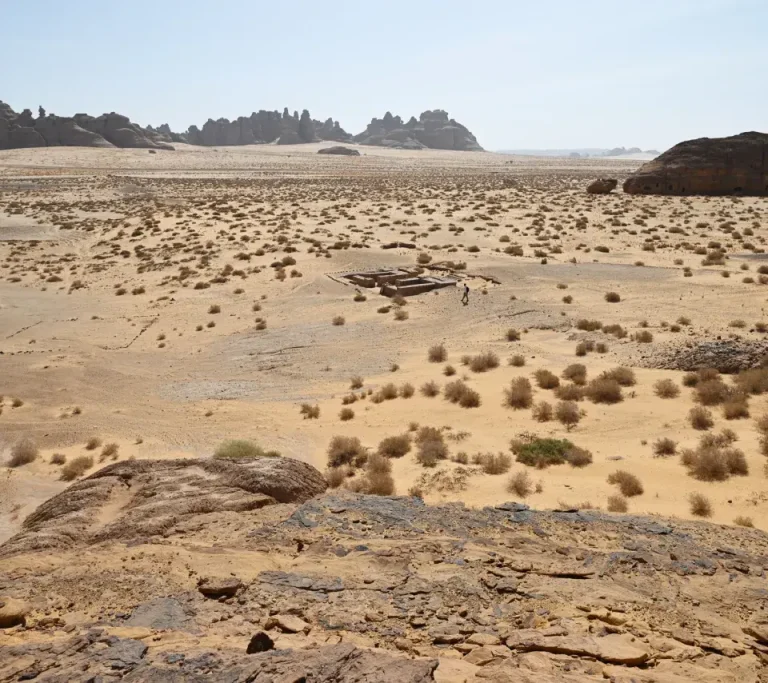
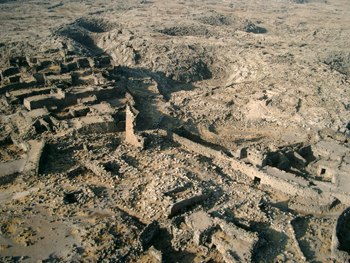
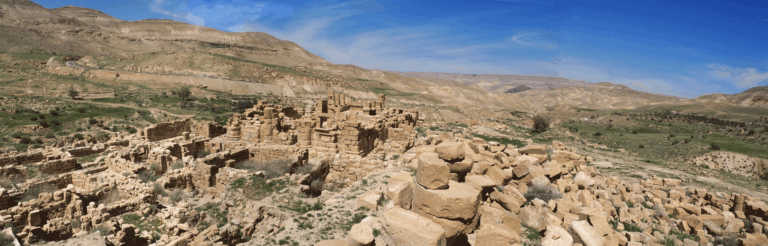
Since 2019, its studies have focused on seven archaeological sites from the Greco-Bactrian period (3rd–2nd century BCE), forming an exceptional group, to help us better understand the civilization that created them, its modes of settlement in the territory, its defensive, cultural, and technical practices. All of these sites experienced later occupations, so we also seek to understand their decline (confrontation with nomads who invaded the region in the 2nd century BCE?) and, for some of them, their evolution into the Kushan period (1st century BCE–3rd century CE).
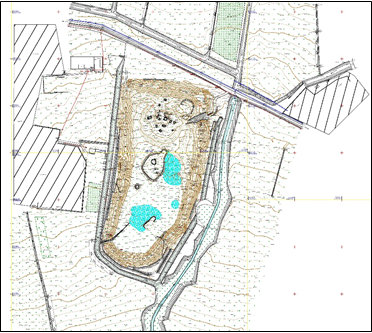
These sites are located in the Danghara region, less than twenty kilometers from the Vakhsh River, which flows to the north and west of the valley, more than 150 km upstream from Takht-i Sangin. The pottery, stone objects (column bases, capitals, votive objects), and coins found there allow them to be associated with the same cultural group, and their immediate proximity (they are located a few kilometers from each other) provided them with direct visual contact. Each situated on a watercourse, five of them were founded on the foothills of the Zimistan mountain to the north of the Tayr Su valley, and two are in the plain, Zol-i Zard and Mazar Todjeddin (the latter from the Kushan period). The exact nature of these sites is still unknown (fortresses, sanctuaries, simple settlements?).
In 2022 and 2023, geophysical surveys were carried out on three sites, and in 2021, 2022, and 2024, a geomatics program included all of their geographic and topographic data.
To date, Zol-i Zard is the only one of them that has not been reoccupied by a village or a cemetery, nor destroyed; surveyed twice by Tajik archaeologists (E. Denisov and T. Filimonova), it revealed Greco-Bactrian artifacts, and later medieval and modern ones.
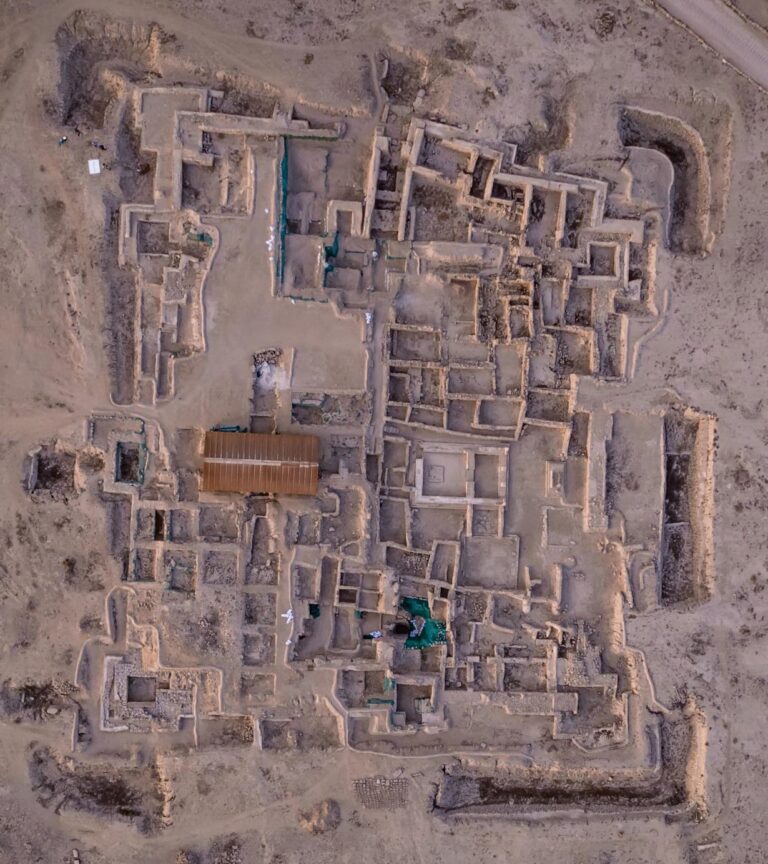
In 2019 and 2020, we were able to carry out its topographic survey and, since 2021, excavations. Roughly rectangular in shape, the site is surrounded by mud brick walls (pahsa) preserved up to 10 m above the lowest point and equipped with 14 towers. The site contains several mounds that represent accumulations of archaeological remains (tépés).
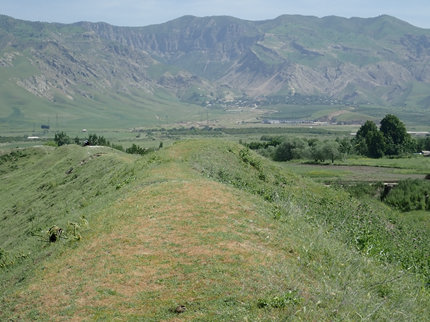
One of them (tepe C) covers a water resurgence that is ancient and indicates an elaborate water supply system, still in operation. Although it is largely transformed into a marsh today, our work revealed built levels at its base that we have yet to characterize. Excavation of the northeast trench uncovered the thickness of the rampart built in pahsa, which rests on levels probably from the Kushan period. The southwest gate dates from the 14th century and may correspond to a repair of the ramparts, a hypothesis that future excavations will help clarify. Tepe A, the largest one, located in the northern part of the site, includes a large carefully constructed building made of mud bricks and coated with lime, which several coins have helped date to the 14th century. On the eastern part of this tell, our excavations have uncovered several burials (including one possibly Samanid, 9th–10th century) and structures that still need to be characterized; the deepest levels reached allow us to approach the period of Antiquity.
Finally, Tell B, located centrally on the site, seems to consist mostly of ancient levels despite some medieval reoccupation.
Regarding the other sites, we specifically worked at Pushing on the mountain foothills, where a large modern trench exposes the ancient levels, and we conducted surveys across all the settlements.
Site preservation
In 2022, the mission became aware of risks of destruction at the Zol-i Zard site, and together with the Dushanbe Institute, the Dushanbe Architecture Bureau, and the Danghara Municipality, was able in 2023 to stop the threat of urbanization to part of the ancient and medieval site.
Also in 2023, the mission proposed specific protection zones for the Zol-i Zard and Mazar Todjeddin sites.
UNESCO Listing
In July 2025, UNESCO listed ten archaeological sites of the ancient Khuttal kingdom (7th-8th centuries) in Tajikistan as World Heritage Sites (https://whc.unesco.org/en/list/1627/), thus recognizing their high historical and archaeological value. Among them are the two sites of Zol-i Zard and Makbarai Mavlono Todjeddin (Mazar Todjeddin), for which the mission contributed to the preparation of the nomination file and to their preservation.
The research is conducted within the framework of the Franco-Tajik Archaeological Mission of Southern Tajikistan, led by Mathilde Gelin (CNRS) and Tatiana Guermanovna Filimonova (IHAET). It is supported by OrAM, by the Ministry of Europe and Foreign Affairs, by the Geops laboratory of Paris Saclay University, by ARSCAN, by the Academy of Sciences of Tajikistan, by the A. Donish Institute of History, Archaeology and Ethnography in Dushanbe, by the Tajik Ministry of Culture, by the French Embassy in Tajikistan, and by the ArchéoWorlds Association.
Participating members OrAM:
– Gelin Mathilde, archéologist, CNRS, french director (2019-2024) ;
– Blanc Pierre-Marie, archéologist, CNRS (2019) ;
– Bombeau Valère, archéologist, Paris 1 Panthéon-Sorbonne University (2023-2024);
– Ghasemi Parsa, archéologist, Paris 1 Panthéon-Sorbonne University (2022).
Participating members ARSCAN :
– Bordeaux Olivier, archéologist-numismatist, CNRS, “Archéologie de l’Asie centrale” team (2021-2023).
Autres participants :
– Filimonova Guermanovna Tatiana, archéologist, IHAET, co-director tadjike (2019-2024);
– Yakubov Yusufsho, archéologist, IHAET, “Académie des Sciences du Tadjikistan” (2019-2022);
– Davtian Gourguen, géomatician, CNRS, Laboratory “CEPAM-UMR 7264, “Dynamique des peuplements et des paysages” team (2021-2022, 2024);
– Karaev Asleddin, archéologist, IHAET/ministère de la Culture (2021-2024);
– Saintenoy Albane, géophysician, Laboratory GEOPS-UMR 8148, Paris-Saclay University (2022-2023);
– Lambert Rémi, géophysician, Laboratory GEOPS-UMR 8148, Paris-Saclay University (2022-2023);
– Zeyen Hermann, géophysician, Laboratoire GEOPS-UMR 8148, Paris-Saclay Univesity (2023);
– Ashurmadov Islom, archéologist, IHAET (2021-2024);
– Sultanmamadov Shambe, topograph, “Institut national unitaire de projets d’entreprise” of Douchanbé (2019-2020);
– Abdulloev Sarvar, topograph, “Institut national unitaire de projets d’entreprise” of Douchanbé (2019-2020).
Bibliography
- Denisov E. P., « Отчёт о работе Дангаринского отряда в 1974 г. » [Rapport sur le travail de l’équipe de Danghara en 1974], Археологические работы в Таджикистане [Travaux archéologiques du Tadjikistan] 14, 1979, p. 214-230.
- Denisov E. P., « Работы в Дангаринском районе в 1981 г. » [Travaux dans le district de Danghara en 1981], Археологические работы в Таджикистане [Travaux archéologiques du Tadjikistan] 21, 1988, p. 289-296.
- Denisov E. P., « Изучение памятников античного времени на территории Дангаринского района (работы 1984 г.) » [Étude de sites d’époque antique dans le district de Danghara (travaux de 1984)], Археологические работы в Таджикистане [Travaux archéologiques du Tadjikistan] 25, 1993, p. 273-282.
- Denisov E. P., Yakubov Yu., Археологические памятники средего течения реки Вахш (По материалам раскопок и разведок древних и средниевековых памятников в Дангаринском и Нурекском районах) [Sites archéologiques du cours moyen de la rivière Vakhsh (d’après le matériel tiré des fouilles et des prospections de sites anciens et médiévaux dans les districts de Danghara et de Nurek)], Mémoire universitaire, Faculté d’Histoire, Université de Douchanbé, 1973.
- Filimonova T. G., Akhmetzianov M. R., « Поисковые работы по составлению археологической карты Дангаринского района в 2009 году » [Travaux de prospection pour la carte archéologique du district de Danghara en 2009], Археологические работы в Таджикистане [Travaux archéologiques du Tadjikistan] 35, 2009, p. 57-114.
- Gelin M., Yakubov Yu., Filimonova T.G., Bordeaux O., Davtian. G., Ashurmadov I., Karaev A., Ghasemi P., Saintenoy A., Lambert R., “Исследования Археологической миссии Южного Таджикистана в 2022 году” [Recherches de la Mission archéologique du Tadjikistan méridional en 2022], Археологические работы в Таджикистане [Travaux archéologiques du Tadjikistan], 45, 2024, p. 312-336.
- Gelin M., Yakubov Yu., Filimonova T. G., Davtian G., Bordeaux O., Каraev А., Аshurmadov I., “Исследования Таджикско-Французской Археологической миссии Южного Таджикистана в 2021 году” [Recherches de la mission tadjiko-française du Tadjikistan méridional en 2021], Археологические работы в Таджикистане [Travaux archéologiques du Tadjikistan], 44, 2023, p. 196-222. https://hal.science/hal-04223826v1
- Gelin M., « Mission archéologique du Tadjikistan méridional. Nouvelles recherches en 2019-2020 », Культурное наследие Таджикистана в археологической и междисциплинарной интерпретации. Сборник статей в честь юбилея Татьяны Германовны Филимоновой [Le patrimoine culturel du Tadjikistan, interprétation archéologique et pluridisciplinaire. Recueil d’articles en l’honneur de l’anniversaire de Tatiana Guermanovna Filimonova], éd. G. R. Karimova, Douchanbé, 2022, p. 149-164. https://hal.archives-ouvertes.fr/hal-03258080v1
- Gelin M., Yakubov Yu., Filimonova T. G., Bordeaux O., Davtian G., Ashurmadov I., Karaev A., « Исследования Археологической миссии Южного Таджикистана в 2021 году » [Recherches de la Mission archéologique du Tadjikistan méridional en 2021], Археологические работы в Таджикистане [Travaux archéologiques du Tadjikistan] 44 (sous presse).
- Yakubov Yu., Khudjageldiev T., Kurbanov Sh., « О работах Кулябского археологического отряда на городище Золи Зард в 2008 г. », [À propos des travaux de l’équipe archéologique de Kulyab sur la colonie de Zoli Zard en 2008], Археологические работы в Таджикистане [Travaux archéologiques du Tadjikistan] 34, 2010, p. 247-284.
- Yakubov Yu., « Отчет о совместной Таджикско-французской археологической экспедиции в Дангаре в 2018 г » [Rapport de l’expédition archéologique conjointe tadjiko-française à Danghara en 2018], Археологические работы в Таджикистане [Travaux archéologiques du Tadjikistan] 43, 2023, p. 109-137. (Il s’agit en fait de la campagne de 2019).